

There are moments in life when we are called to stand our ground, to open our hearts, and to face the world with unwavering confidence. Warrior II (Virabhadrasana II) captures that very spirit. It is a yoga pose that symbolizes courage, patience, and the power of calm awareness. Whether you are new to yoga or a seasoned practitioner, this pose reminds you that true strength is not found in aggression but in grounded stillness.
- Understanding the Essence of Warrior II (Virabhadrasana II)
- How to Perform Warrior II (Virabhadrasana II)
- The Physical Benefits of Warrior II (Virabhadrasana II)
- The Mental and Emotional Benefits
- The Symbolism of Warrior II
- Breathing Techniques in Warrior II
- Common Mistakes to Avoid
- Modifications for Different Levels
- Building a Routine with Warrior II
- The Energy Flow of Warrior II
- Emotional Connection and Mindfulness
- The Spiritual Meaning
- Continuing the Journey
- Step-by-Step Guide to Practicing Warrior II (Virabhadrasana II)
- Key Alignment Tips for a Perfect Warrior II
- Benefits of Warrior II (Virabhadrasana II)
- Common Mistakes and How to Correct Them
- Modifications and Variations
- The Emotional and Spiritual Lessons of Warrior II
- How Long to Hold Warrior II (Virabhadrasana II)
- Incorporating Warrior II into Your Routine
- The Energy Connection in Warrior II
- The Journey of Growth Through Warrior II
- Final Thoughts: The Warrior Within You
Understanding the Essence of Warrior II (Virabhadrasana II)
The name Virabhadrasana comes from the Sanskrit words “Vira,” meaning hero or warrior, and “Bhadra,” meaning blessed or auspicious. Warrior II (Virabhadrasana II), the second in the Warrior series, honors the legendary warrior Virabhadra — a symbol of focused power guided by compassion.
This pose is not merely about physical alignment; it’s about embodying mental clarity and emotional steadiness. The extended arms represent balance and expansion, while the grounded legs root you deeply into the earth. It is a powerful reminder that strength and grace can coexist.
When you enter Warrior II (Virabhadrasana II), you are not just striking a pose — you are taking a stance for your inner truth. The front body looks forward, symbolizing courage, while the back body remains open, showing trust and acceptance. It’s a posture of openness in strength.
How to Perform Warrior II (Virabhadrasana II)
Though it appears simple, Warrior II requires focus, stability, and awareness. Here’s how to step into this empowering pose:
- Begin in Mountain Pose (Tadasana): Stand tall at the top of your mat, feet together, spine long, and shoulders relaxed.
- Step Wide: Move your feet about 3 to 4 feet apart. Your stance should feel stable but not strained.
- Turn Your Feet: Rotate your right foot 90 degrees so your toes point toward the front of your mat. Turn your left foot slightly inward.
- Align Heels: Ensure your front heel aligns with the arch of your back foot for proper balance.
- Bend the Front Knee: Lower your front knee until it’s directly above your ankle. Keep your thigh parallel to the floor if possible.
- Extend the Arms: Stretch both arms out to the sides at shoulder height, palms facing down.
- Engage the Core: Pull your navel slightly in to stabilize your torso.
- Gaze Forward: Look over your front hand softly, keeping your neck long and your shoulders relaxed.
- Hold and Breathe: Stay here for 5–10 deep breaths. Feel the strength of your legs and the openness of your heart.
- Switch Sides: Straighten your front leg and repeat on the other side.
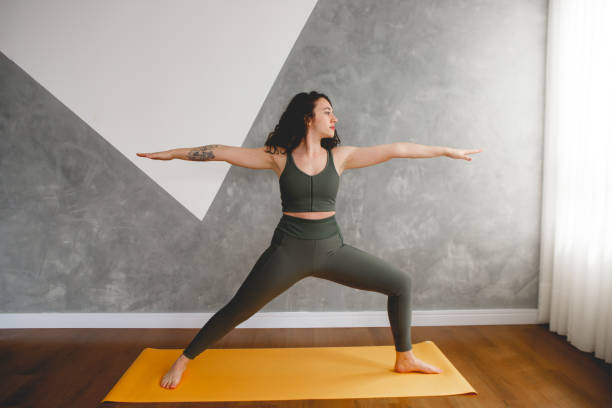
This sequence connects your physical form to your breath, allowing stillness within strength.
The Physical Benefits of Warrior II (Virabhadrasana II)
Practicing Warrior II consistently offers a wide range of physical benefits. It’s a full-body workout that builds endurance and flexibility while promoting body awareness.
| Area | Benefit |
|---|---|
| Legs and Hips | Strengthens thighs, calves, and glutes; opens the hip joints. |
| Core | Improves balance and stability through abdominal engagement. |
| Shoulders and Arms | Tones upper body muscles while improving posture. |
| Spine | Encourages alignment and relieves tension from sitting. |
| Ankles and Feet | Builds strength and improves grounding. |
The longer you hold Warrior II, the more you feel your body growing both firm and flexible.
The Mental and Emotional Benefits
While the physical rewards are evident, the mental transformation Warrior II (Virabhadrasana II) brings is just as powerful.
When you stand in this pose, your body becomes a symbol of focus. Your gaze is steady, your breath is calm, and your awareness expands. This mental discipline can translate into daily life, helping you stay centered in stressful situations.
Emotionally, Warrior II opens the chest and heart, allowing energy to flow freely. Many practitioners report feelings of empowerment, courage, and emotional release. It’s a pose that teaches patience — you learn to hold discomfort and transform it into confidence.
The Symbolism of Warrior II
Every detail of Warrior II (Virabhadrasana II) carries symbolic meaning. Your feet represent grounding — a connection to the earth and your roots. Your bent front leg shows readiness to move forward, while the extended back leg embodies stability and strength from the past.
Your arms, stretched wide, represent balance — one pointing to the future, one toward the past, while your heart remains in the present. This perfect harmony of time and awareness makes Warrior II more than a posture; it’s a moving meditation.
In ancient stories, the warrior Virabhadra rose from the earth as an embodiment of righteous anger turned to divine strength. In yoga, Warrior II channels that same energy, transforming raw emotion into purposeful calm.
Breathing Techniques in Warrior II
Breath gives life to the pose. Without mindful breathing, Warrior II becomes an empty shape. The way you breathe determines how deeply you connect to its essence.
- Inhale Deeply: Feel the expansion in your chest and ribs. Let your breath lift your energy.
- Exhale Slowly: Root your feet deeper into the mat and feel grounded.
- Find Rhythm: Maintain slow, even breathing throughout. Inhale for strength, exhale for release.
Breathing this way not only improves focus but also calms the nervous system, allowing you to remain present in each moment.
Common Mistakes to Avoid
Even experienced yogis sometimes make subtle errors that can affect the effectiveness of Warrior II (Virabhadrasana II). Here are a few things to watch for:
- Front Knee Collapsing Inward: Always align your knee directly over your ankle to protect your joints.
- Leaning Forward: Keep your torso centered over your hips.
- Tension in Shoulders: Relax your shoulders away from your ears, even as your arms extend outward.
- Unstable Back Foot: Ground your back foot firmly to maintain balance.
- Holding Breath: Keep your breathing smooth and steady.
Correcting these small details transforms the posture into something more powerful and harmonious.
Modifications for Different Levels
Everyone’s body has its own rhythm, flexibility, and strength. The beauty of Warrior II lies in its adaptability.
| Variation | How to Do It | Purpose |
|---|---|---|
| Beginner’s Warrior II | Keep a shorter stance and reduce knee bend. | Builds foundation and stability. |
| Chair-Assisted Warrior II | Rest your front thigh lightly on a chair. | Ideal for people recovering from injuries. |
| Wall Warrior II | Stand with your back heel near a wall for balance. | Helps maintain proper alignment. |
| Deep Warrior II | Increase your stance and lower your hips further. | Enhances strength and endurance. |
Whether gentle or advanced, each variation captures the same essence of courage and mindfulness.
Building a Routine with Warrior II
Warrior II (Virabhadrasana II) works beautifully as part of a balanced yoga flow. Try pairing it with other postures that complement its grounding energy:
- Mountain Pose (Tadasana) – Center your body.
- Triangle Pose (Trikonasana) – Stretch the sides and strengthen your balance.
- Reverse Warrior (Viparita Virabhadrasana) – Open your heart and expand your chest.
- Extended Side Angle (Utthita Parsvakonasana) – Deepen your hip flexibility.
- Warrior III (Virabhadrasana III) – Transition to balance and focus.
Practicing these in sequence connects strength, flexibility, and mindfulness in a beautiful rhythm.
The Energy Flow of Warrior II
Energetically, Warrior II activates the root and sacral chakras. The root chakra (Muladhara) governs grounding, security, and stability, while the sacral chakra (Svadhisthana) controls creativity and emotional flow.
As your legs press into the mat, you stimulate grounding energy, giving you a sense of strength and steadiness. Meanwhile, the open arms and chest encourage creativity and emotional release. This balance between grounding and expansion is what makes Warrior II deeply energizing.
Emotional Connection and Mindfulness
In a world that constantly demands movement and achievement, Warrior II (Virabhadrasana II) teaches the art of being present and still. You stand strong, look ahead, and yet remain fully aware of your breath and body.
This awareness creates emotional clarity. You begin to see challenges not as obstacles but as opportunities for growth. Practicing this pose regularly reminds you that stability comes not from rigidity but from conscious awareness.
Every time you hold the posture a little longer, you strengthen not only your muscles but also your willpower. You realize that you are capable of enduring more than you thought — and that calm strength is your greatest power.
The Spiritual Meaning
On a deeper spiritual level, Warrior II is about integrating opposites — strength and softness, action and awareness, earth and sky. It teaches you that life, like yoga, is about balance. You can be both fierce and compassionate, powerful and gentle.
This pose invites you to live with purpose, to move with intention, and to stand tall in your truth. When practiced mindfully, it becomes a moving meditation on inner peace and courage.
Continuing the Journey
Warrior II (Virabhadrasana II) is more than just a yoga posture; it’s a metaphor for life. Each time you step into the pose, you practice being present, balanced, and strong. Over time, you carry that strength into everything you do — whether facing daily stress, emotional storms, or personal challenges.
In the next part, we’ll explore how to deepen your connection with Warrior II, how to link it with breath and mindfulness, and how it can transform your energy and perspective from within.
Step-by-Step Guide to Practicing Warrior II (Virabhadrasana II)
Let’s explore the proper way to perform this iconic pose to ensure safety, balance, and full benefit.
- Start in Mountain Pose (Tadasana): Stand tall with your feet together and your arms relaxed at your sides. Take a few deep breaths to center yourself.
- Step Your Feet Apart: Gently step your feet about 3.5 to 4 feet wide, depending on your height and comfort level.
- Turn Your Feet: Rotate your right foot 90 degrees so that the toes face forward. Your left foot should be slightly turned inward (about 15 degrees).
- Align Your Heels: Make sure your front heel aligns with the arch of your back foot to create stability.
- Bend Your Front Knee: Slowly bend your right knee until it’s directly above your ankle, forming a 90-degree angle. Keep your back leg straight and strong.
- Extend Your Arms: Stretch your arms out to the sides at shoulder height, parallel to the floor, with your palms facing down.
- Gaze Over Your Front Hand: Look softly over your right fingertips, maintaining a calm and steady gaze.
- Engage Your Core: Pull your navel slightly toward your spine to stabilize your torso.
- Hold the Pose: Stay in this position for 30 seconds to one minute, breathing deeply. Then switch sides.
Key Alignment Tips for a Perfect Warrior II
To perform Warrior II (Virabhadrasana II) safely and effectively, keep these alignment points in mind:
- Ensure your front knee does not extend past your ankle.
- Keep your shoulders relaxed and away from your ears.
- Engage your back leg muscles to distribute your weight evenly.
- Avoid leaning your torso forward; the body should be upright and balanced over the hips.
- Keep your arms strong but not rigid, allowing energy to flow through your fingertips.
Benefits of Warrior II (Virabhadrasana II)
The Warrior II (Virabhadrasana II) offers a remarkable range of benefits that extend beyond the physical. Here’s how it transforms your body, mind, and energy:
| Benefit Type | Description |
|---|---|
| Physical Strength | Builds strength in the legs, ankles, shoulders, and arms. |
| Flexibility | Opens the hips and groin, improving mobility. |
| Balance & Stability | Enhances body coordination and posture control. |
| Endurance | Increases stamina through sustained holding. |
| Mindfulness | Teaches mental focus and calm under pressure. |
| Energy Flow | Boosts circulation and invigorates the body. |
| Confidence | Cultivates courage and self-assurance. |
Common Mistakes and How to Correct Them
Even experienced practitioners can fall into small misalignments that limit the effectiveness of Warrior II (Virabhadrasana II). Here are common mistakes and how to fix them:
- Front knee collapsing inward: Keep your knee aligned with your ankle and pointing over your second toe.
- Torso leaning forward: Keep your upper body upright and balanced between your legs.
- Arms drooping: Maintain a firm but relaxed extension from fingertip to fingertip.
- Hips not squared: Gently open your hips toward the side of the mat to maintain alignment.
Modifications and Variations
Yoga is meant to meet you where you are, so don’t hesitate to modify Warrior II (Virabhadrasana II) according to your ability.
- If your hips feel tight: Shorten your stance slightly to ease pressure.
- For more balance: Place a block or sturdy object next to your front thigh for support.
- To challenge yourself: Add gentle movements like flowing your arms overhead with each inhale and returning to shoulder height on each exhale.
- For strength training: Hold the pose longer or add gentle pulses in the bent knee.
The Emotional and Spiritual Lessons of Warrior II
Every yoga pose carries a message, and Warrior II (Virabhadrasana II) speaks of inner resilience and peaceful determination. It encourages you to face life’s difficulties not with aggression but with grace. The pose teaches us that true strength lies in calmness — in the ability to hold still while the world moves around you.
When you practice this pose regularly, you develop not just physical strength but emotional stability. The deep breathing calms your mind, and the extended stance reminds you to stay grounded even when facing challenges. It’s a meditation in motion — one that builds confidence with every breath.
How Long to Hold Warrior II (Virabhadrasana II)
For beginners, hold the pose for 20 to 30 seconds on each side. As you progress, aim for one minute or longer. Remember, the focus is not on how long you hold it but how present and balanced you feel in the posture. Always synchronize your breath — inhaling deeply through the nose and exhaling fully to release tension.
Incorporating Warrior II into Your Routine
The Warrior II (Virabhadrasana II) can be practiced on its own or as part of a flowing sequence like the Sun Salutation or Warrior Flow. Here’s a simple integration example:
- Begin with Mountain Pose
- Transition into Warrior I
- Open into Warrior II
- Flow into Reverse Warrior
- Finish with Triangle Pose
This flow balances strength, flexibility, and focus, allowing you to move gracefully from one posture to another.
The Energy Connection in Warrior II
This pose activates the root (Muladhara) and solar plexus (Manipura) chakras — centers of stability, confidence, and self-power. By grounding through your feet and extending through your arms, you create an energetic balance between earth and sky. It’s a reminder that you can be both steady and powerful, gentle yet unstoppable.
The Journey of Growth Through Warrior II
Every time you step into Warrior II (Virabhadrasana II), you are embarking on a small journey of transformation. The initial discomfort in your thighs teaches endurance; the stillness in your breath cultivates focus. Over time, this pose becomes a metaphor for your life — teaching you to stand tall, stay grounded, and face every challenge with composure.
In the beginning, your legs may tremble, and your shoulders may burn. But as you breathe through it, you begin to understand that growth comes from embracing the challenge, not avoiding it. The Warrior II is a mirror reflecting your inner strength — reminding you that peace and power can exist together.
Final Thoughts: The Warrior Within You
The Warrior II (Virabhadrasana II) pose is not just about achieving a perfect shape on the mat; it’s about discovering balance within your own life. Every time you enter the stance, you ignite a spark of courage and mindfulness. You begin to see yourself not as someone fighting battles but as someone gracefully overcoming them.
In a world that often feels fast and overwhelming, this pose becomes a sanctuary — a reminder that true strength comes from calm persistence and open-hearted awareness. So, the next time you find yourself in Warrior II, breathe deeply, ground your feet, lift your arms, and remember — the real warrior is already within you.