

There are few yoga postures that combine strength, stability, and flow as beautifully as the Extended Side Angle Pose. Known in Sanskrit as Utthita Parsvakonasana, this pose represents more than a physical stretch—it’s a reminder of how balance, endurance, and grace can come together in perfect alignment, much like a finely tuned car engine operating at its best.
For anyone who has ever admired the way a luxury car glides smoothly on the highway—powerful yet controlled—the Extended Side Angle Pose mirrors that same harmony in human movement. It engages every part of your body, from your grounded feet to the tips of your fingers stretching toward the sky. It’s strong, elegant, and deeply grounding—just like the hum of a perfectly balanced motor.
In today’s fast-paced life, where people are often overwhelmed with deadlines and distractions, this pose offers a moment of calm power. It’s a combination of strength and serenity—a physical meditation that recharges both the body and mind.
Let’s explore how this incredible yoga posture can transform your energy, improve your balance, and unlock hidden strength within you.
Understanding the Essence of Extended Side Angle Pose
The Sanskrit name Utthita Parsvakonasana translates to:
- Utthita = Extended
- Parsva = Side
- Kona = Angle
- Asana = Pose
Together, it means “the extended side angle posture.” The name itself suggests expansion and openness. When you practice this pose, you literally extend your energy outward—from your rooted legs to your fingertips—while maintaining deep grounding and balance.
Physically, the Extended Side Angle Pose strengthens your thighs, opens your hips, stretches your side body, and engages your core. Emotionally, it instills confidence, stability, and clarity. You feel anchored yet free—a rare combination that brings you closer to your natural rhythm.
Spiritually, the posture encourages you to stretch beyond your comfort zone. Just as a driver leans into a curve with trust in their machine, you lean into your body’s strength with faith in yourself.
How to Perform the Extended Side Angle Pose Step-by-Step
If you are new to yoga or simply looking to deepen your practice, here’s how you can perform Extended Side Angle Pose correctly.
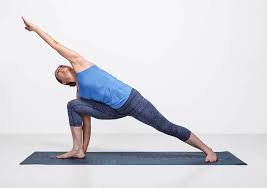
Step 1: Begin with the Foundation
Start in Tadasana (Mountain Pose). Stand tall with your feet together, spine straight, and shoulders relaxed. Take a few deep breaths to center yourself.
Step 2: Move into Warrior II (Virabhadrasana II)
Step your feet about 3.5 to 4 feet apart. Turn your right foot outward 90 degrees and your left foot slightly inward. Extend your arms out to the sides, parallel to the floor, palms facing down. Bend your right knee directly over your right ankle, keeping your thigh parallel to the floor.
Step 3: Transition to the Side Angle
From Warrior II, inhale deeply, and as you exhale, bring your right forearm to rest lightly on your right thigh or place your right hand on the mat beside your right foot (depending on flexibility). Stretch your left arm over your ear, reaching toward the front of your mat.
Step 4: Engage the Whole Body
Press your left foot firmly into the ground. Stretch through your left fingertips while grounding through your back heel. Feel a long line of energy extending from your heel to your fingertips. Keep your chest open and gaze softly toward your raised arm.
Step 5: Hold and Breathe
Stay in the pose for 5–7 deep breaths. Each inhale should lengthen your body; each exhale should help you ground deeper into the pose.
Step 6: Release and Switch Sides
Inhale to rise back up into Warrior II, and then repeat on the other side.
The Physical Benefits of Extended Side Angle Pose
Practicing Extended Side Angle Pose regularly transforms your strength, flexibility, and balance. Below is a breakdown of its physical benefits:
| Area of Focus | Benefit |
|---|---|
| Legs and Hips | Builds strength and flexibility in thighs, calves, and hips |
| Core Muscles | Engages abs and obliques for balance and toning |
| Spine | Improves alignment and releases tension from the back |
| Shoulders and Chest | Opens the chest and enhances breathing capacity |
| Circulation | Stimulates blood flow, energizing the entire body |
| Stamina | Builds endurance, promoting long-term resilience |
Every time you practice this pose, you’re not just stretching your muscles—you’re tuning your entire body. It’s like checking the oil, cleaning the filters, and ensuring every internal system works together smoothly.
Just as a performance car requires alignment for smooth handling, your body too needs alignment for efficiency and grace. The Extended Side Angle Pose helps restore that inner alignment.
The Mental and Emotional Impact
Yoga isn’t only about the physical—it’s also deeply emotional. The Extended Side Angle Pose activates the Manipura Chakra, located near your solar plexus, which governs personal power, confidence, and decision-making.
When you hold the pose and breathe through the tension, you’re not just strengthening your body—you’re strengthening your willpower. You learn to face resistance with patience, turning discomfort into determination.
There’s an emotional release that comes when you stretch your side body and open your heart space. It’s as if every breath reminds you that you can face challenges with grace. You begin to trust your body’s balance the way a driver trusts their car on a sharp turn—focused, fearless, and fluid.
Why Car Lovers Connect with the Energy of this Pose
If you’re someone who loves cars, you’ll understand the relationship between design, balance, and power. The Extended Side Angle Pose expresses all of that through movement.
- The Base (Legs): Like a car’s tires gripping the road, your legs provide the foundation. They keep you stable and grounded.
- The Chassis (Core): Your core acts as the car’s framework—it stabilizes every motion.
- The Engine (Breath): Your breath fuels every stretch, providing the energy to move with purpose.
- The Finish (Arms and Hands): Just as a car’s body is designed for aerodynamics, your arms create an extended line that allows energy to flow freely.
Practicing Extended Side Angle Pose gives you the same feeling as driving your favorite car down an open road—it’s fluid, powerful, and controlled.
Common Mistakes to Avoid
Like any well-tuned system, the pose demands precision. Avoiding mistakes keeps your practice safe and effective.
- Over-Bending the Front Knee: Ensure your knee stays directly above your ankle. Overbending puts pressure on your joints.
- Collapsing the Chest: Keep your chest open and lifted; don’t allow your torso to roll downward.
- Locked Elbows or Knees: Maintain a slight bend to protect your joints.
- Holding Breath: Never forget to breathe. Breath is the true engine of yoga.
- Straining for Depth: Flexibility grows with consistency; don’t force your body to stretch beyond its limit.
Each correction is like fine-tuning the suspension of a sports car—small adjustments lead to smoother performance and greater balance.
A Pose That Symbolizes Life’s Flow
Life, much like yoga, is about finding balance through constant motion. The Extended Side Angle Pose teaches you to stay grounded in one part of your body while reaching forward with another—to hold stability while still expanding.
When you balance your strength and your stretch, you realize how much potential your body holds. You feel lighter, more in control, and incredibly empowered. The awareness you gain on the mat begins to flow into your daily life. You become calmer in stress, more patient in frustration, and more focused on your goals.
Just as a well-maintained vehicle can handle any terrain, a well-balanced body and mind can handle any challenge life presents.
Preparation Poses Before Extended Side Angle Pose
Before you dive into Utthita Parsvakonasana, warm up with these preparatory asanas to open your hips, legs, and shoulders:
- Triangle Pose (Trikonasana) – Stretches sides and improves alignment.
- Warrior II (Virabhadrasana II) – Strengthens thighs and improves stability.
- Lizard Pose (Utthan Pristhasana) – Opens hips deeply.
- Side Stretch (Parsva Tadasana) – Warms up the torso and obliques.
- Low Lunge (Anjaneyasana) – Improves flexibility in the groin and thighs.
When the body is warmed up, Extended Side Angle Pose feels natural, powerful, and rewarding.
Holding the Pose with Awareness
When you are in the Extended Side Angle Pose, focus on the following cues:
- Feel your back foot pressing firmly into the mat.
- Engage your inner thighs as if pulling them toward each other.
- Lengthen the side of your torso and keep your chest lifted.
- Relax your face and jaw.
- Let your breath flow effortlessly.
Every second in this pose is a chance to connect deeper with your own strength.
The Deeper Meaning of Extended Side Angle Pose
In Sanskrit, Utthita Parsvakonasana doesn’t just describe a shape; it tells a story about expansion and connection. “Utthita” means extended — symbolizing growth, space, and freedom. “Parsva” means side, referring to the side body — the path where breath and energy flow. “Kona” means angle, representing precision, and “Asana” means pose, reflecting stability.
When these elements unite, the Extended Side Angle Pose becomes an act of reaching beyond your limits while staying grounded in your truth. It’s a conversation between earth and sky — between strength and surrender.
When your feet grip the ground and your fingertips reach out, you create a perfect diagonal line of energy that symbolizes your life journey — rooted in the past, present in the moment, and reaching toward the future.
Energy Flow: The Engine of Your Body
Think of your body as a high-performance engine. Every inhale draws energy in, just like fuel filling a combustion chamber. Every exhale releases used energy, clearing the system for efficiency.
In the Extended Side Angle Pose, this energy flow becomes visible. Your back leg represents stability — the foundation that keeps you grounded. Your front leg represents action — the force that pushes you forward. And your torso, stretched from the hip to the fingertips, becomes the transmission line connecting power to purpose.
When your body finds alignment, the “engine” of your energy runs smoothly. You feel light, capable, and connected. There’s no noise, no friction — just effortless power.
The Role of Breath in the Pose
Breath is the invisible mechanic that fine-tunes your practice. In Extended Side Angle Pose, the breath guides your body through the layers of tension and resistance.
Here’s how to breathe during the pose:
- Inhale deeply through your nose – Feel your rib cage expand, lengthening your spine.
- Exhale slowly – Sink deeper into your front leg while keeping your chest open.
- Continue breathing steadily – Let every inhale lift and expand your body, and every exhale anchor and stabilize it.
Over time, this rhythmic breathing enhances lung capacity, calms the nervous system, and brings focus to the present moment.
Breathing here is like maintaining steady acceleration while driving — smooth, controlled, and focused. You’re not racing; you’re gliding.
Emotional Strength Through Physical Stillness
There’s something powerful about staying still in Extended Side Angle Pose. Your muscles burn, your breath deepens, and your mind begins to whisper doubts. But as you stay longer, those whispers fade, replaced by a calm knowing: You can hold this.
This is more than physical endurance — it’s emotional resilience. Every moment you remain steady in discomfort, you train yourself to stay calm in life’s turbulence. You develop patience, courage, and self-belief.
It’s similar to how a car handles under pressure — a smooth drive isn’t about avoiding bumps but mastering control over them. The same is true for this pose; control doesn’t mean rigidity — it means flow with awareness.
Spiritual Connection: Reaching Beyond the Body
At a deeper level, Extended Side Angle Pose opens your heart and awakens your intuition. The long, stretched spine and open chest align energy centers (chakras), allowing prana — the life force — to circulate freely.
- The Root Chakra (at the base of your spine) gives grounding and stability.
- The Sacral Chakra (in your lower abdomen) enhances creativity and flow.
- The Solar Plexus Chakra (around your navel) fuels personal power and confidence.
- The Heart Chakra (center of your chest) opens for compassion and love.
When energy flows smoothly through these chakras, you feel light yet powerful — like a perfectly tuned machine, effortlessly moving in balance with its environment.
Practicing this pose regularly brings emotional balance, helping you release stress and reconnect with peace — the kind of inner calm that mirrors the sound of a quiet, well-maintained engine.
Advanced Variations of the Extended Side Angle Pose
Once you’ve mastered the basic form, you can deepen your practice through variations that add challenge and intensity.
- Bound Extended Side Angle Pose (Baddha Utthita Parsvakonasana)
- From the basic position, thread your lower arm under your bent thigh.
- Reach your upper arm behind your back and clasp your hands.
- Open your chest and gaze upward.
- This variation increases flexibility in the shoulders and chest while deepening the twist.
- Half-Bound Pose
- Keep your lower arm on your thigh and only wrap the upper arm behind your back.
- It’s a great transitional step for beginners moving toward the full bind.
- Extended Side Angle Pose on the Forearm
- Instead of placing your hand on the floor, lower your forearm to the mat inside your front foot.
- This provides better support and a gentler stretch for beginners.
- Revolved Side Angle Pose (Parivrtta Parsvakonasana)
- This advanced version adds a twist, engaging your obliques and detoxifying your body.
- It strengthens your digestion and challenges your balance.
Each variation invites new awareness, building flexibility, strength, and humility — qualities that refine your body like precision engineering.
Common Challenges and How to Overcome Them
Every practitioner, beginner or advanced, faces hurdles in this pose. Here’s how to address them:
| Challenge | Cause | Solution |
|---|---|---|
| Loss of balance | Weak core or misalignment | Engage your core muscles and keep your back heel grounded |
| Shoulder tension | Overreaching the top arm | Relax your shoulder and extend naturally |
| Hip stiffness | Limited flexibility | Warm up with hip-opening poses like Lizard Pose |
| Shallow breathing | Overexertion | Slow your movement and breathe consciously |
| Fatigue | Holding too long without rest | Build endurance gradually; focus on quality over duration |
Consistency and patience are the key mechanics of improvement.
Building a Routine Around Extended Side Angle Pose
If you want to integrate Extended Side Angle Pose into your daily yoga routine, try the following sequence:
- Mountain Pose (Tadasana) – Centering and grounding.
- Warrior II (Virabhadrasana II) – Strengthens and prepares the legs.
- Extended Side Angle Pose (Utthita Parsvakonasana) – Full body expansion.
- Triangle Pose (Trikonasana) – Improves balance and flexibility.
- Wide-Legged Forward Bend (Prasarita Padottanasana) – Relaxes and releases tension.
- Corpse Pose (Savasana) – Restores peace and balance.
Practiced together, these poses work like a fine-tuned system — each one preparing, complementing, and completing the next.
The Mental Metaphor – Driving with Focus and Fluidity
For car enthusiasts, the Extended Side Angle Pose feels familiar. It’s about flow — that magical balance between speed and control.
When you’re driving down a winding road, your focus sharpens. You feel the connection between the steering, tires, and road. Every motion becomes intentional. In the same way, when you hold this yoga pose, you feel every muscle, breath, and movement working in harmony.
This synchronization builds mindfulness. It teaches that strength without control leads to burnout — but strength with awareness leads to mastery.
The pose reminds us that both life and machines perform best when we balance power with grace.
Emotional Reflection: What the Pose Teaches You About Life
The Extended Side Angle Pose is a lesson in courage and surrender. It tells you:
- Stay grounded when life tests your balance.
- Reach out for your dreams without losing your roots.
- Keep your heart open, even when challenged.
- Breathe deeply — because every challenge becomes easier with breath.
When you rise from this pose, you feel not only stronger but also more confident, more centered, and more peaceful. It’s as though the noise of the world fades, and only your inner rhythm remains — calm, steady, and sure.
Scientific Benefits and Wellness Impact
Modern research supports what ancient yogis have practiced for centuries. Extended Side Angle Pose:
- Increases stamina and endurance.
- Improves spinal flexibility and posture.
- Enhances oxygen intake through chest expansion.
- Promotes digestive efficiency.
- Reduces anxiety by activating the parasympathetic nervous system.
- Improves lymphatic flow, aiding detoxification.
These benefits mirror the same precision and efficiency a car achieves after professional tuning — the system runs cleaner, smoother, and more powerfully.
The Harmony of Body and Mind
When all parts of this pose align — breath, balance, and focus — your body and mind move as one. It’s not about perfection but connection. You begin to notice that every time you step on the mat, you’re learning to control not just your posture but your response to life.
The Extended Side Angle Pose becomes a reflection of your own journey — a reminder that the path to strength is paved with patience, and the route to balance lies in awareness.
Final Thoughts: The Road Within
The Extended Side Angle Pose is not just a yoga posture; it’s an experience of integration. It unites the physical, emotional, and spiritual aspects of being — grounding you in the moment while inspiring you to stretch further.
For car lovers, this pose mirrors the perfection of a beautifully engineered machine — powerful yet elegant, steady yet dynamic. It teaches that real strength is quiet, composed, and consistent.
Every time you step into Utthita Parsvakonasana, think of it as tuning your body — refining every movement, every breath, and every thought to align with your highest potential.
In a world that races fast, this pose reminds you to slow down, breathe, and balance. Because just like a car runs best when well cared for, your body and mind thrive when maintained with awareness and love.
So, take a deep breath, ground your feet, extend your arms, and let the Extended Side Angle Pose carry you into a state of pure strength and serenity.