

There’s something deeply powerful about starting your day with movement, strength, and awareness. Just as an engine warms up before a race, our bodies too need ignition—a way to awaken power, grace, and confidence. Among all the yoga postures that spark this awakening, none does it quite like the Upward-Facing Dog (Urdhva Mukha Svanasana).
The Upward-Facing Dog is not merely a stretch or a backbend; it is an act of rising, of expansion, of self-belief. It’s a pose that reminds us that even after every challenge or fall, we can lift ourselves up again—with poise, with strength, and with heart. For car lovers, imagine this as tuning your inner engine. Every breath revs up your energy, every stretch realigns your structure, and every hold polishes your inner drive.
Understanding the Essence of the Upward-Facing Dog
At its core, the Upward-Facing Dog is a powerful heart-opening pose that combines strength and flexibility. It stretches the chest, shoulders, and abdomen while engaging the arms, wrists, and back muscles. It’s both grounding and elevating—a combination of earth and air energy.
In Sanskrit, Urdhva Mukha Svanasana translates to “Upward-Facing Dog Pose.” “Urdhva” means upward, “Mukha” means face, and “Svanasana” means dog pose. The name itself reflects an image of alertness, confidence, and grace—just like a proud dog standing tall, chest open to the world, eyes forward, ready for the day’s adventure.
This posture has been practiced for centuries, forming a crucial link in traditional vinyasa yoga sequences. It symbolizes resilience—the art of rising with courage and poise, no matter what the challenge.
The Story Behind the Pose
In the world of yoga, poses are not just physical postures—they carry emotional and symbolic depth. The Upward-Facing Dog represents awakening and courage. When you lift your heart upward and open your chest, it’s like saying, “I’m ready for life.”
Ancient yogis viewed this pose as a reminder that strength without openness is incomplete. Just as a car’s engine must balance power with control, our bodies must balance strength with flexibility. The Upward-Facing Dog embodies this harmony perfectly—strong arms and legs grounding the body while the chest expands freely into the air.
It’s also symbolic of renewal. Just as dawn breaks after the darkest night, this pose teaches us that there’s always a moment to rise again—stronger, clearer, and more radiant.
The Physical Benefits of the Upward-Facing Dog
The Upward-Facing Dog is a full-body energizer. When performed correctly, it strengthens multiple muscle groups and stimulates vital systems in the body.
Here’s what it offers:
- Strengthens the Arms and Wrists:
Supporting your body weight on your hands develops stability and muscle endurance. - Improves Posture:
The extension of the spine helps counter the effects of sitting or hunching, aligning your back and shoulders naturally. - Opens the Chest and Lungs:
This pose expands the chest cavity, improving respiratory capacity and energizing the body with fresh oxygen. - Boosts Digestive Health:
The gentle stretch across the abdomen stimulates digestive organs, aiding metabolism. - Enhances Flexibility:
It opens the shoulders, chest, and hip flexors, which are often tight from long hours of sitting. - Energizes the Nervous System:
By increasing circulation and oxygen flow, it helps fight fatigue and boosts mental clarity. - Relieves Mild Depression and Stress:
The heart-opening action of this pose naturally uplifts mood and emotional balance.
The Upward-Facing Dog doesn’t just stretch the body—it recharges it. It’s like giving your inner engine a fine-tune, preparing you to run smoother, stronger, and longer through life’s races.
Step-by-Step Guide to Performing the Upward-Facing Dog
To truly master the Upward-Facing Dog, technique matters. Precision in alignment ensures that you reap its full benefits without strain.
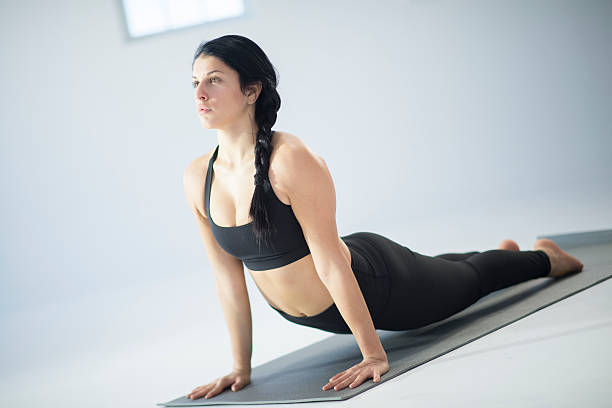
Here’s how to perform it correctly:
- Start Position:
Begin lying flat on your stomach with your legs extended straight back, toes pointing. Place your palms beside your lower ribs, fingers pointing forward. - Engage Your Legs:
Press the tops of your feet firmly into the mat. Keep your thighs active and lifted off the ground. This engagement protects your lower back. - Press Through the Hands:
As you inhale, straighten your arms and lift your chest upward. Your body weight should be evenly distributed between your hands and the tops of your feet. - Lift the Chest and Open the Heart:
Broaden your shoulders, lift your chest, and keep your elbows slightly soft. Roll the shoulders back and down. - Engage the Core:
Draw your navel gently toward your spine to support your lower back. Avoid collapsing into the lumbar spine. - Gaze Forward or Slightly Upward:
Keep your neck long and relaxed. Avoid overextending it. - Hold and Breathe:
Stay for 15–30 seconds, breathing deeply. Feel the energy flow through your entire body—up from your legs, through your spine, into your heart. - Release Gracefully:
Exhale slowly and lower yourself back to the mat. You can transition into Child’s Pose or Downward-Facing Dog to release the back.
Table: Key Alignment Checklist for Upward-Facing Dog
| Alignment Focus | Correct Position | Common Mistake | Correction Tip |
|---|---|---|---|
| Hands | Under shoulders | Too far forward | Align wrists under shoulders |
| Elbows | Slightly bent | Locked elbows | Soften elbows slightly |
| Legs | Engaged and lifted | Relaxed thighs | Press tops of feet down firmly |
| Shoulders | Rolled back and down | Shoulders near ears | Broaden collarbones and drop shoulders |
| Lower Back | Supported by core | Overarching spine | Engage abdominal muscles |
| Gaze | Slightly upward | Neck cranked back | Keep neck neutral and long |
When done correctly, this posture feels both strong and freeing. You’ll sense your chest expand, your spine lengthen, and your breath deepen. It’s an empowering position—just like sitting behind the wheel of a powerful car, ready to take on the open road.
The Connection Between Yoga and Driving
For many people who love cars, yoga may seem like an entirely different world. But in reality, they share a deep similarity: both demand focus, control, and balance.
When you practice Upward-Facing Dog, you’re training the same qualities that define a skilled driver—awareness, coordination, and precision. In both, you must control speed, maintain balance, and stay mindful of your environment.
Just as a car needs regular maintenance to perform at its best, your body and mind need yoga to stay strong, flexible, and balanced. Each stretch becomes a tune-up; each breath, a fuel for clarity.
Emotional Healing Through the Pose
The Upward-Facing Dog is often described as a heart-opener. Emotionally, that means it helps release feelings of sadness, fatigue, or self-doubt. When your chest expands, so does your emotional capacity.
Many people hold stress in their shoulders and chest—this pose gently opens that space. It’s a physical reminder that vulnerability is not weakness; it’s strength in its purest form.
When you lift your chest and gaze forward, you send a signal to your mind: “I am ready to move forward.” That single thought can change everything—from your confidence at work to your calmness in everyday challenges.
Breathwork in the Upward-Facing Dog
Breathing is the engine of yoga. Without it, movement is empty.
In Upward-Facing Dog, each breath becomes a flow of energy. Inhale deeply to lift and expand your chest; exhale slowly to release any tension. Think of each breath as a gear shift—moving you smoothly between strength and serenity.
Practicing deep breathing here improves lung capacity and calms the nervous system. Over time, you’ll notice your endurance increasing—both physically and mentally.
Table: Breath Pattern for the Pose
| Action | Breathing Technique | Purpose |
|---|---|---|
| Inhale | Lift the chest and expand lungs fully | Energizes and opens the heart |
| Hold | Maintain gentle awareness of breath | Builds focus and balance |
| Exhale | Soften shoulders and engage core | Releases tension and stabilizes spine |
Common Mistakes to Avoid
Every powerful pose has challenges, and Upward-Facing Dog is no exception. Recognizing and correcting mistakes early ensures you build strength safely.
| Mistake | Why It’s Harmful | How to Fix It |
|---|---|---|
| Overarching the lower back | Causes strain | Engage core muscles and keep thighs active |
| Shoulders near ears | Restricts breathing | Roll shoulders back and down |
| Relaxed legs | Reduces balance | Keep legs and glutes engaged |
| Collapsing the chest | Limits energy flow | Broaden chest and lift through the sternum |
The Inner Meaning Behind the Upward-Facing Dog
Every yoga pose tells a story, and the Upward-Facing Dog speaks the language of hope and resilience. The pose teaches us that life’s strength isn’t found in resistance but in openness. When you lift your chest and look upward, you’re physically expressing courage and emotional surrender at the same time.
It’s the embodiment of balance—firmly grounded yet gracefully lifted. Like a high-performance car that hugs the road while accelerating forward, your body in this pose demonstrates controlled power. It’s strength combined with fluidity, effort balanced with grace.
There’s an emotional beauty in the way the heart opens in this pose. In a world where we often close ourselves off due to fear or stress, the Upward-Facing Dog asks us to do the opposite—to expand, to breathe, and to believe.
The Science Behind the Power
Modern science has begun to recognize what ancient yogis knew all along—the Upward-Facing Dog profoundly benefits both body and mind.
- Boosts Circulation:
When your chest expands and lungs open, oxygen flow improves. This helps nourish muscles and organs, enhancing overall vitality. - Stimulates the Nervous System:
The gentle compression of the spine activates nerve centers that promote focus and calm. - Improves Spinal Health:
The backbend strengthens spinal muscles, improving alignment and flexibility. It’s a counter-movement to slouching and hunching that’s common in modern life. - Releases Endorphins:
As your posture improves and tension eases, your body releases endorphins—natural mood boosters. - Supports Digestive Function:
The abdominal stretch stimulates the stomach, liver, and intestines, promoting healthier digestion.
Each of these effects works together to create a harmonious state of well-being. After all, yoga is not about perfection—it’s about connection. The Upward-Facing Dog connects your breath with your body, your strength with your spirit.
Integrating Upward-Facing Dog into Your Practice
The Upward-Facing Dog is most commonly used in vinyasa sequences, often flowing between poses like Chaturanga Dandasana (Four-Limbed Staff Pose) and Downward-Facing Dog (Adho Mukha Svanasana). But beyond being a transitional pose, it can also stand alone as a complete energizer.
If you’re new to yoga or simply want to incorporate this posture into your morning flow, here’s a simple sequence you can follow:
- Start in Plank Pose.
Keep your body straight from head to heels, engaging your core. - Lower into Chaturanga Dandasana.
Bend your elbows close to your body, keeping them at a 90-degree angle. - Transition to Upward-Facing Dog.
As you inhale, press the tops of your feet and palms into the mat, lift your chest, and extend your spine upward. - Open Your Chest and Lift Through the Heart.
Let your shoulders roll back, allowing the heart to rise naturally. - Move to Downward-Facing Dog.
Exhale, tuck your toes, and lift your hips into an inverted “V” shape.
Practicing this flow even for five minutes daily can reawaken your energy, improve posture, and cultivate confidence.
Comparing Upward-Facing Dog with Cobra Pose
Beginners often confuse the Upward-Facing Dog with Cobra Pose (Bhujangasana). While they share similarities, there are key distinctions that change how your body experiences the pose.
| Aspect | Upward-Facing Dog | Cobra Pose |
|---|---|---|
| Arm Engagement | Arms are fully straight | Elbows remain slightly bent |
| Leg Position | Thighs and knees lifted | Thighs and pelvis rest on the floor |
| Intensity | Deeper backbend | Gentler backbend |
| Muscles Engaged | Arms, chest, wrists, core, and legs | Primarily back and arms |
| Suitable For | Intermediate to advanced | Beginners and all levels |
If you’re new to yoga or still developing core strength, begin with Cobra Pose. Once your back muscles are stronger, progress to the Upward-Facing Dog for a more powerful, elevated stretch.
The Spiritual Dimension of Upward-Facing Dog
Beyond the physical, yoga is a spiritual language—a dialogue between your mind and body. The Upward-Facing Dog teaches the art of openness. By physically lifting your heart, you symbolically lift your spirit.
In yogic philosophy, this pose activates the Anahata Chakra, also known as the heart chakra. Located at the center of your chest, this chakra governs love, compassion, and connection. When balanced, it allows you to give and receive love freely—not only to others but to yourself.
Practicing the Upward-Facing Dog regularly can help clear emotional blockages, release grief, and invite peace into your daily rhythm. It’s not just a stretch—it’s an act of self-healing.
Emotional Connection — Rising from Within
Life often pushes us down—through stress, doubt, or fatigue. The Upward-Facing Dog offers the physical and emotional strength to rise again. It teaches you that even when you feel low, you can lift yourself with breath and intention.
When you hold the pose, you’re not only lifting your chest—you’re elevating your perspective. That’s the emotional power of this posture. You begin to see challenges not as walls but as opportunities to grow.
Many practitioners describe feeling a sense of freedom after holding this pose—a feeling that comes from both physical release and mental clarity. This sense of liberation is one of the greatest gifts yoga can offer.
Building Strength and Flexibility
Consistency is the key to mastering the Upward-Facing Dog. Over time, it builds physical strength and inner confidence.
Here’s a simple weekly plan to gradually deepen your practice:
| Day | Focus | Duration | Goal |
|---|---|---|---|
| Monday | Basic alignment | 5 minutes | Build awareness of posture |
| Tuesday | Add vinyasa flow | 10 minutes | Increase flexibility |
| Wednesday | Focus on breath control | 5 minutes | Improve coordination |
| Thursday | Add core engagement drills | 10 minutes | Strengthen lower back |
| Friday | Full flow practice | 15 minutes | Balance body and breath |
| Saturday | Gentle stretch session | 10 minutes | Prevent stiffness |
| Sunday | Rest and reflection | — | Reflect on progress |
Gradual progression ensures your body adapts safely while maximizing benefits. Remember, mastery isn’t about perfection—it’s about patience and consistency.
The Upward-Facing Dog in Everyday Life
The lessons learned from the Upward-Facing Dog go far beyond the yoga mat. It teaches posture in every sense of the word—not just how you carry your body, but how you carry yourself in life.
When you practice opening your chest and lifting your head high, you naturally project confidence. You feel more alive, more present, and more in control. It becomes a reminder to face life’s challenges with the same strength and calm that the pose represents.
For those who love cars and driving, think of this pose as your body’s version of pressing the accelerator—building momentum while staying balanced and controlled. It’s that beautiful intersection between energy and elegance.
Tips for Perfecting the Upward-Facing Dog
- Warm Up First:
Prepare with gentle stretches like Cat-Cow Pose or Cobra Pose. - Engage Your Core:
Always protect your lower back by tightening your abdominal muscles. - Focus on Alignment:
Make sure your wrists are aligned under your shoulders and your thighs are lifted. - Avoid Rushing:
Move slowly and breathe deeply. Quality is more important than speed. - Listen to Your Body:
If you feel strain in your lower back, lower down slightly or bend your elbows. - End with Counterposes:
Follow with Child’s Pose or Downward-Facing Dog to release tension.
Table: Quick Recap of Benefits
| Benefit Type | Key Effects of Upward-Facing Dog |
|---|---|
| Physical | Strengthens arms, shoulders, and back; opens chest and hips |
| Mental | Boosts focus and energy levels |
| Emotional | Reduces stress, builds confidence, opens the heart |
| Spiritual | Activates heart chakra and enhances emotional clarity |
Words from the Heart — The Pose of Courage
Practicing the Upward-Facing Dog is like a conversation with yourself—a promise to rise, no matter how many times life tests you. It’s about learning that true strength comes from grace, and real beauty lies in balance.
Every time you step onto your mat and lift your chest, you embody the essence of self-belief. You tell the world, and yourself, “I can rise again.”
When your body opens, your heart follows. When your breath deepens, your thoughts quiet down. And when your gaze lifts upward, your spirit starts to soar.
So, the next time you find yourself feeling low or uncertain, remember this simple yet powerful lesson from the Upward-Facing Dog: You are stronger than you think, more resilient than you know, and more capable than you imagine.
In Conclusion
The Upward-Facing Dog (Urdhva Mukha Svanasana) is far more than a yoga posture—it’s a journey of empowerment. It teaches us to face the world with strength and grace, to breathe through challenges, and to rise every time we fall.
Whether you’re a yoga enthusiast, a car lover seeking inner balance, or simply someone looking to find peace and power within, this pose offers a daily reminder of growth and gratitude.
Because in the end, like a beautifully tuned engine, your body and soul both perform best when they move in harmony—strong, open, and alive.