

There’s a quiet kind of magic in balance — that moment when your body, mind, and breath come together in a single rhythm. Among the many yoga poses that symbolize this perfect balance, Tripod Headstand yoga stands tall as both a physical and spiritual achievement. It’s not just a pose — it’s a journey toward discovering your inner power, patience, and courage.
What Is Tripod Headstand Yoga?
The Tripod Headstand (Mukta Hasta Sirsasana A) is one of the most graceful inversions in yoga. Unlike the traditional headstand where the forearms support the head, this version uses the hands placed firmly on the mat beside the head — forming a stable tripod shape. Your head and both hands act as the three strong points of a triangle, creating a balanced foundation for the body to lift upward.
This pose requires focus, strength, and trust — not just in your body, but in your ability to rise, quite literally, above fear and hesitation.
In Sanskrit:
- Mukta means “free.”
- Hasta means “hand.”
- Sirsasana means “headstand.”
So, the name beautifully translates to “Free Hands Headstand,” symbolizing freedom, control, and the liberation of self through mindful balance.
The Spiritual Meaning Behind Tripod Headstand Yoga
Every inversion in yoga has a deeper purpose beyond the physical. When we turn our bodies upside down, we change how we view the world. The Tripod Headstand yoga pose teaches us to see things from a new perspective — to let go of our need for control and to embrace balance even in uncertainty.
In traditional yoga philosophy, headstands are often called the “King of Asanas.” They are said to awaken the Sahasrara Chakra, the crown energy center located at the top of your head. This chakra connects us to higher consciousness, creativity, and spiritual clarity.
When you lift into Tripod Headstand yoga, you’re not only strengthening your body — you’re also lifting your spirit, allowing your inner energy to flow more freely. You begin to feel lighter, more aware, and more connected to yourself.
Why Tripod Headstand Yoga Is So Powerful
The power of this pose lies in its simplicity — a still body balanced on three points, supported by focus and breath. But behind that simplicity is an incredible range of benefits for the body and mind.
Here’s why many yogis consider this pose life-changing:
| Aspect | Benefits of Tripod Headstand Yoga |
|---|---|
| Physical Strength | Builds strong shoulders, arms, and core muscles. |
| Balance and Stability | Improves coordination and body awareness. |
| Circulation | Increases blood flow to the brain, boosting focus and energy. |
| Stress Relief | Calms the mind and relieves anxiety by reversing blood flow. |
| Confidence | Overcoming fear of falling develops courage and resilience. |
| Posture Improvement | Strengthens spine alignment and body control. |
Preparing Your Mind and Body for Tripod Headstand Yoga
Before you begin your Tripod Headstand yoga journey, preparation is key. This is not a pose to rush into — it’s one to grow into with patience and care. Think of it as a friendship you build with your body, one breath at a time.
1. Warm Up the Body
Your body needs to be warm, open, and active before going upside down. Begin with gentle stretches and foundational poses that activate your core and shoulders.
Some excellent preparatory poses include:
- Downward-Facing Dog (Adho Mukha Svanasana)
- Dolphin Pose
- Plank Pose
- Child’s Pose (Balasana)
- Cat-Cow Stretch
These poses strengthen your arms, open your shoulders, and prepare your neck and spine for safe inversion.
2. Engage Your Core
Your core is your anchor in Tripod Headstand yoga. It’s what keeps you stable and prevents pressure from building on your neck. Practice core-engaging poses like:
- Boat Pose (Navasana)
- Forearm Plank
- Low Boat Holds
A strong core gives you control and confidence as you rise into your inversion.
3. Build Shoulder and Arm Strength
Your shoulders act as your primary support system in this pose. Practice push-up variations, dolphin push-ups, and arm-balancing postures like Crow Pose (Bakasana). These will prepare you for the arm engagement needed in your tripod.
4. Cultivate Mindful Focus
One of the most beautiful lessons of Tripod Headstand yoga is mental stillness. You must be completely present — no distractions, no rush. A few minutes of breath meditation before you start can help you center your thoughts and prepare for the challenge ahead.
How to Do Tripod Headstand Yoga (Step-by-Step Guide)
Now that your body and mind are ready, let’s learn how to move into the pose safely.
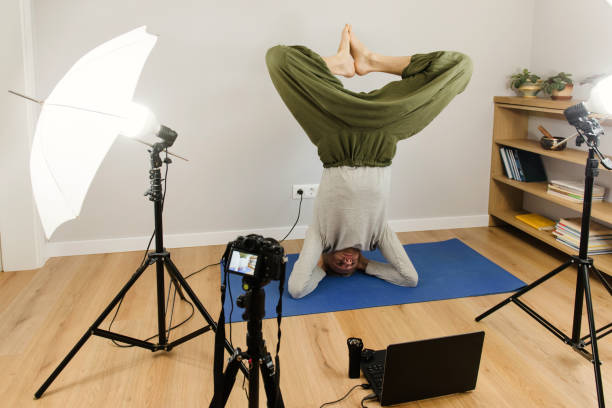
Step 1: Find Your Foundation
- Start in a kneeling position.
- Place your hands flat on the mat, shoulder-width apart.
- Bring the top of your head gently to the floor between your hands.
- Your head and hands form a stable triangle — the base of your tripod.
Step 2: Lift the Hips
- Straighten your legs slowly and walk your feet closer toward your head.
- Your hips should start stacking above your shoulders.
- Keep your neck neutral and your weight balanced evenly across your head and hands.
Step 3: Engage and Lift One Leg
- Slowly bend one knee and draw it toward your chest.
- Keep breathing calmly.
- Engage your core as you test your balance.
Step 4: Lift the Other Leg
- When you feel stable, lift the other knee toward your chest.
- At this stage, your knees can rest gently on your triceps.
- This is a half tripod position — stay here until you feel balanced.
Step 5: Extend the Legs Upward
- Engage your core deeply and slowly extend both legs straight up.
- Point your toes and keep your body in a straight line.
- Stay balanced between your head and hands — do not collapse into your neck.
Step 6: Breathe and Hold
- Keep breathing slowly and deeply.
- Hold the pose for 5–10 breaths, or longer as your practice grows.
- Feel the stillness and strength in your body.
Step 7: Gentle Descent
- Slowly lower one leg, then the other.
- Return to Child’s Pose to relax and release your neck and spine.
Common Mistakes to Avoid
Even experienced yogis can make small mistakes in inversions. Here’s what to watch out for when practicing Tripod Headstand yoga:
| Mistake | Why It’s Risky | Correction |
|---|---|---|
| Placing too much weight on the head | Can strain the neck | Distribute weight evenly through hands and arms |
| Rushing into the pose | Increases risk of falling | Move slowly and with control |
| Collapsing shoulders | Weakens the base | Keep your shoulders lifted and active |
| Holding breath | Builds tension | Maintain slow, steady breathing |
| Overarching lower back | Reduces balance | Engage core to align spine |
Safety Tips for Beginners
- Always practice on a yoga mat or near a wall for support.
- Avoid this pose if you have neck injuries, high blood pressure, or dizziness.
- Never force yourself into the position — progress gradually.
- Remember, yoga is not about perfection; it’s about connection.
Emotional Transformation Through Tripod Headstand Yoga
Beyond the physical benefits, there’s something truly emotional about achieving your first Tripod Headstand yoga. For many people, it symbolizes rising above self-doubt and fear. The moment you balance upside down, something shifts inside — your heart beats stronger, your breath steadies, and you realize that confidence isn’t about being fearless, but about moving forward despite fear.
This pose can become a daily reminder that you are stronger than your limits. Each attempt brings you closer to stillness, patience, and grace.
When you hold the pose, upside down, the world feels quiet — like you’re suspended in your own peace. It’s not about impressing anyone; it’s about feeling proud of how far you’ve come.
Advanced Variations of Tripod Headstand Yoga
Once you’ve mastered the traditional Tripod Headstand yoga, you can explore new variations that challenge your stability and increase flexibility. Each variation adds a unique dimension to your practice, encouraging you to expand your limits with grace.
1. Tripod Headstand with Lotus Legs (Padmasana in Mukta Hasta Sirsasana A)
In this version, you fold your legs into the lotus position while balancing upside down.
This pose deepens hip flexibility and demands precise core control.
It represents balance between grounding and elevation — staying calm even in challenge.
Steps:
- From your basic tripod position, once balanced, gently bend your knees.
- Bring your right foot onto your left thigh, then your left foot onto your right thigh.
- Engage your core, keep your spine straight, and breathe calmly.
- Hold for 5–10 breaths, then release carefully.
2. Tripod Headstand Split (Urdhva Prasarita Eka Padasana)
This variation stretches the hamstrings while testing your balance.
How to Do:
- From the base pose, slowly lower one leg down while keeping the other extended upward.
- Keep your hips square and core tight.
- Alternate legs to maintain symmetry.
This variation symbolizes balance in opposites — control and surrender, stillness and movement.
3. Tripod Headstand to Forearm Balance Transition
A dynamic and empowering flow for advanced practitioners.
Steps:
- Begin in Tripod Headstand yoga.
- Slowly bend your elbows and shift your weight into your forearms.
- Transition into Forearm Stand (Pincha Mayurasana) with smooth control.
- Reverse the movement to return to tripod position.
This transition enhances your body awareness and strengthens your arm stability — teaching that movement can be fluid even in stillness.
4. Tripod Headstand Pike Entry
For those seeking a challenge in entry and exit control.
Steps:
- Start with your feet together and slowly lift them upward without bending your knees.
- Engage your lower abs and maintain steady breath.
- The slower the lift, the deeper the control.
This variation requires not just strength, but focus — a reminder that mastery is not speed, but stillness in motion.
Breathing Techniques During Tripod Headstand Yoga
Breath is the soul of yoga. Without it, a pose is just exercise. With it, the pose becomes meditation. In Tripod Headstand yoga, controlled breathing turns fear into calm and effort into flow.
1. Ujjayi Pranayama (Victorious Breath)
This is the ideal breathing method for inversions.
How to Practice:
- Slightly constrict the back of your throat.
- Inhale and exhale through your nose with a soft ocean-like sound.
- Keep the rhythm slow and deep.
This breath calms the nervous system and helps you maintain focus while upside down.
2. Equal Breathing (Sama Vritti Pranayama)
Perfect for balancing your mind and keeping rhythm.
Technique:
- Inhale for 4 counts, exhale for 4 counts.
- Keep your breath steady throughout the pose.
- Focus on your inner calm.
Balanced breathing helps maintain steadiness — reminding you that breath is your anchor when gravity feels reversed.
3. Mindful Exhalation
Whenever you feel shaky or tense, gently lengthen your exhale.
This tells your body you are safe and in control — a powerful message during challenging poses like Tripod Headstand yoga.
The Emotional Journey of Tripod Headstand Yoga
There’s a special kind of emotion that comes from doing something you once believed impossible. The first time your feet leave the ground and you find balance, you feel a spark — a mix of surprise, joy, and quiet pride.
Tripod Headstand yoga becomes more than a physical act; it becomes a symbol of self-belief. Each time you practice, you’re reminded that strength is not just in the arms — it’s in the heart.
1. Overcoming Fear
Inversions challenge one of our most basic fears — falling.
But every small victory teaches trust.
With each attempt, you learn that courage grows through patience, not perfection.
2. Building Inner Confidence
As you improve, your posture, breath, and mind grow stronger together.
This newfound confidence spills beyond the mat — into your work, relationships, and dreams. You start to trust yourself more deeply.
3. Emotional Release
When you’re upside down, blood flows differently, the heart beats stronger, and emotions surface. Many practitioners describe a release — of old thoughts, stress, or self-doubt. The pose becomes a form of emotional healing.
Tripod Headstand Yoga Progression: From Beginner to Master
If you’re just starting, don’t rush. Each stage of learning has its beauty. Below is a gentle roadmap to help you grow safely and steadily.
| Level | Focus Area | Practice Tips |
|---|---|---|
| Beginner | Foundation & Strength | Practice Downward Dog, Dolphin, and Plank. Use a wall for support. |
| Intermediate | Balance & Alignment | Work on lifting both legs with control. Focus on core stability. |
| Advanced | Fluid Transitions | Add leg variations, transitions, and longer holds. Develop breath awareness. |
The secret to mastery is consistency. Even 5 minutes daily can create deep transformation if done mindfully.
Integrating Tripod Headstand Yoga into Daily Practice
You don’t need a special time or place to practice. Morning practice energizes your body and awakens clarity, while evening practice helps release stress and tension.
A simple daily routine might look like this:
| Time | Pose/Practice | Duration |
|---|---|---|
| 5 min | Gentle warm-up (Cat-Cow, Shoulder Rolls) | 5 minutes |
| 5 min | Dolphin Pose or Forearm Plank | 5 minutes |
| 10 min | Tripod Headstand yoga practice | 10 minutes |
| 3 min | Child’s Pose (Rest) | 3 minutes |
| 5 min | Seated Meditation & Deep Breathing | 5 minutes |
This 25–30 minute sequence is enough to maintain steady progress and mindfulness.
Scientific Benefits of Inversions Like Tripod Headstand Yoga
Modern science also supports what ancient yogis knew centuries ago — inversions rejuvenate both mind and body.
- Boosts Circulation: Improves blood flow to the brain, enhancing concentration and memory.
- Balances Hormones: Stimulates the endocrine system, supporting emotional balance.
- Enhances Focus: Promotes clarity and alertness by stimulating neural activity.
- Improves Lymphatic Flow: Assists the body in detoxifying naturally.
- Relieves Anxiety: Activates the parasympathetic nervous system, creating calmness.
Practicing Tripod Headstand yoga regularly helps the brain function more efficiently while keeping the heart and lungs strong.
Tripod Headstand Yoga and Mindfulness
Every inversion is a reminder of presence. When you’re upside down, distractions disappear. You can’t think about yesterday or tomorrow — only now. That’s what makes Tripod Headstand yoga a meditation in motion.
To deepen mindfulness during your pose:
- Focus your gaze on a single point (Drishti).
- Count your breaths slowly.
- Visualize your body as light and balanced.
- Feel gratitude for your strength and growth.
Mindfulness transforms this asana into a moving prayer — a way of thanking your body for carrying your spirit.
Frequently Asked Questions (FAQs)
1. Is Tripod Headstand yoga safe for beginners?
Yes, if practiced correctly. Start near a wall and progress slowly. Build shoulder and core strength first to prevent neck strain.
2. How long should I hold the pose?
Start with 5–10 seconds. Gradually increase to 1 minute as your confidence grows.
3. Can I do this pose every day?
Yes! Daily practice builds balance and discipline. However, rest if your neck or shoulders feel tired.
4. What if I’m afraid to fall?
Fear is natural. Practice near a wall, or with a folded blanket for comfort. Remember, each attempt makes you braver.
5. Does this pose help with mental clarity?
Absolutely. The reversed blood flow to the brain helps sharpen focus and calm racing thoughts.
6. Is Tripod Headstand yoga good for emotional healing?
Yes. The combination of balance, breath, and stillness often brings deep emotional release and inner peace.
The Deeper Message of Tripod Headstand Yoga
Beyond the strength and skill, this pose teaches one profound lesson — balance is born from trust. When you surrender your fear and rise with calm, you discover a version of yourself that feels limitless.
Every time you come down from Tripod Headstand yoga, it’s not just your body returning to earth — it’s your spirit landing softly, carrying newfound strength and peace.
Yoga is not about reaching perfection. It’s about connecting — to your breath, your courage, and your heart. And when you finally find that balance, even for a moment, you realize that the world feels more stable — not because it changed, but because you did.
Final Thoughts: Rising Beyond the Mat
The Tripod Headstand yoga (Mukta Hasta Sirsasana A) is more than an inversion; it’s a reminder that life, too, is about finding balance through challenge. It teaches that stability doesn’t come from what’s beneath us but from what’s within us.
Every time you lift into the pose, remember — you’re rising not against gravity, but beyond doubt.
Each breath, each attempt, each fall brings you closer to mastery — of the pose, and of yourself.
So, next time you roll out your mat, take a deep breath and begin again.
Let your heart lead, let your mind calm, and let your body rise — steady, graceful, and free.