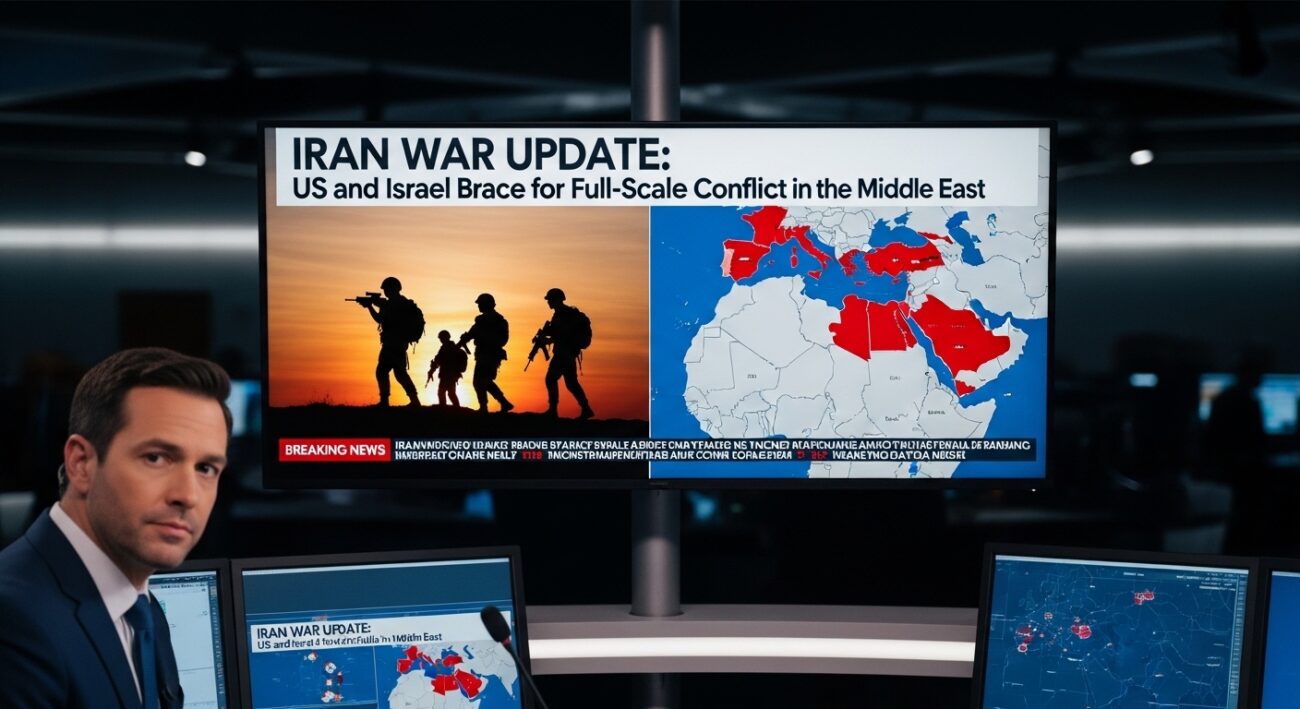
The Middle East is facing one of its most dangerous moments in years. The conflict between Iran and the combined forces of the United States and Israel has entered its tenth day, and there are no signs of stopping. What began as targeted airstrikes has quickly grown into a full-scale military confrontation that involves multiple countries and threatens to disrupt the global economy .
Fighting has spread across the region. Israeli warplanes continue to strike targets deep inside Iran, while Iranian missiles and drones rain down on US military bases and Israeli positions. The situation grows more complex with each passing hour .
Iran Names New Supreme Leader
In a major political development, Iran has appointed a new Supreme Leader. The Assembly of Experts officially named Mojtaba Khamenei as the country’s new leader on Sunday, March 8. He takes over after his father, Ayatollah Ali Khamenei, was killed during the opening days of the war .
The appointment of Mojtaba Khamenei sends a clear message. The hardline cleric has promised to maintain Iran’s confrontational stance against the West. The Islamic Revolutionary Guard Corps has already pledged its loyalty to the new leader, ensuring that Iran’s military response will continue without interruption .
Hours after the appointment, Iran launched fresh missile attacks. State media showed projectiles heading toward Israel bearing the slogan “At Your Command, Sayyid Mojtaba,” demonstrating the new leader’s firm position against US and Israeli forces .
Military Escalation Intensifies
The fighting has reached new levels of intensity. The Israeli Defense Forces report that they have dropped more than 7,500 bombs on Iranian targets over the past week. That is roughly twice the number used in operations against Iran just last year. In total, Israel has conducted more than 3,400 airstrikes since the conflict began .
Key targets have included two of Iran’s most important ballistic missile production facilities in Parchin and Shahrud. Israeli officials say these strikes have significantly damaged Iran’s ability to produce new missiles . On Sunday, Israeli aircraft struck Iranian oil depots and refining facilities in Tehran and Karaj for the first time, causing massive fires and heavy damage to energy infrastructure .
Israeli Prime Minister Benjamin Netanyahu has made his position clear. In a televised statement, he said Israel’s offensive would continue with “full force and uncompromising momentum.” He added that Israel has a well-prepared plan with many surprises aimed at weakening the Iranian leadership .
Iran has not backed down. The IRGC announced the launch of its 29th wave of what it calls “Operation Honest Promise 4.” Iranian forces have fired missiles and drones toward Israeli territory and US-linked targets across the region. According to IRGC figures, Iran has carried out 600 missile strikes and 2,600 drone operations, hitting more than 200 sensitive targets .
Conflict Spreads Across the Region
The war is no longer contained within Iran and Israel. Fighting has spread to multiple countries across the Gulf region .
Bahrain has been hit hard. An Iranian drone strike damaged a desalination plant on the island of Sitra, injuring 32 people. The wounded include four serious cases, among them a 17-year-old girl who suffered severe head and eye injuries and a two-month-old baby. The Al Ma’ameer oil facility was also struck, causing a fire that forced Bahrain’s state-owned energy company to declare force majeure .
Saudi Arabia has also come under attack. Projectiles landed in residential areas, causing civilian casualties. The US State Department has now ordered non-emergency government employees and their family members to leave Saudi Arabia due to safety risks .
Kuwait, Qatar, and the United Arab Emirates have all reported new attacks. Explosions were heard in the Qatari capital Doha, and Iranian missiles have targeted US military bases throughout the region. Al Udeid Air Base in Qatar, which hosts forward components of US Central Command, has been struck multiple times .
A total of 21 people have been killed in the Gulf since Iran began its retaliatory attacks, including 10 civilians and seven US service members .
The United States is responding with a massive military buildup. The USS Abraham Lincoln is already in the area, and the USS Gerald R. Ford is currently in the Red Sea. Now, a third aircraft carrier strike group led by the USS George H.W. Bush is preparing to deploy to the Middle East .
President Donald Trump has stated that US forces have sunk 42 Iranian naval vessels within three days and disabled Iran’s communications systems. He has also made his political objectives clear, stating that he wants “unconditional surrender” from Iran .
Global Economy Feels the Shock
The fighting in the Middle East is sending shockwaves through the global economy. Oil prices have surged to their highest levels since 2022 .
Brent crude futures climbed to $119.50 per barrel, while US West Texas Intermediate hit $119.48. That represents a roughly 30% increase since the conflict began. Some analysts warn that prices could go even higher if the fighting continues .
The reason for the price spike is simple. The Strait of Hormuz is a narrow waterway through which about 20% of the world’s oil passes. Iran has threatened to block the strait, and attacks on shipping have already begun. Iran claims to have struck 17 vessels belonging to the US, Israel, and their allies .
Major oil producers are feeling the impact. Iraq, Kuwait, and the UAE have begun reducing oil production as storage facilities fill up. They cannot ship their oil out safely. The Qatari energy facility, which accounts for about one-fifth of global liquefied natural gas supply, has also halted operations after a drone attack .
The International Monetary Fund is warning about the economic consequences. IMF Managing Director Kristalina Georgieva said that a 10% increase in oil prices persisting through most of the year would result in a 40-basis-point increase in global inflation. She urged policymakers to “think of the unthinkable and prepare for it” .
Stock markets around the world are falling. European markets shed more than 2.5% in morning trading. Asian markets also plunged as investors worried about the economic impact of higher energy prices .
Political Reactions and Diplomatic Efforts
World leaders are watching the conflict with growing concern. The United Nations reports that more than 1,000 locations in Iran have been hit since the war began, and the humanitarian toll continues to mount .
G7 finance ministers are meeting to discuss the situation. One option on the table is releasing strategic oil reserves to help stabilize energy markets. A French government source confirmed that the use of strategic reserves is being considered .
Saudi Arabia has publicly condemned Iran’s attacks. In a statement, the Saudi foreign ministry called the attacks “reprehensible” and said they “cannot be accepted or justified under any circumstances” .
Iran maintains that its actions are defensive. Iranian President Masoud Pezeshkian said in a social media post that Iran remains committed to maintaining friendly relations with countries in the region. However, he emphasized Iran’s right to self-defense in the face of what he described as “military aggression” by the US and Israel .
The Iranian Foreign Ministry issued a statement saying that Iran’s defensive operations will continue until the aggression ceases or until the UN Security Council fulfills its duty to identify the aggressors .
Diplomatic efforts appear stalled. President Trump said any decision to halt military operations would have to be made jointly with Israeli Prime Minister Netanyahu, dampening expectations of an imminent ceasefire .
What Comes Next
The conflict shows no signs of ending soon. Both sides appear dug in and ready for a prolonged fight .
The United States has approved a major weapons sale to Israel, including 12,000 aerial bombs worth about $151.8 million. This indicates that Washington expects the fighting to continue and wants to ensure Israel has the munitions it needs .
Iran’s new Supreme Leader has pledged to resist to the end. The IRGC has shown it can sustain a prolonged campaign, launching wave after wave of missiles and drones .
The economic impact will likely worsen. OCBC analysts warn that a sustained closure of the Strait of Hormuz could rival the energy shock seen during the 2022 Russia-Ukraine conflict. Brent could hold near $100 through mid-year, and maybe higher .
Shipping companies are already pulling out. Maersk has suspended vessel crossings in the Strait of Hormuz, rerouting all services around the Cape of Good Hope. Mediterranean Shipping Company has also suspended bookings for cargo to the Middle East region .
For ordinary people around the world, this means higher prices at the pump and potentially higher costs for many goods. The conflict in the Middle East is no longer a distant problem. It is affecting wallets everywhere .
As the war enters its second week, the only certainty is more uncertainty. The fighting continues, the politics remain tangled, and the global economy holds its breath waiting to see what happens next
