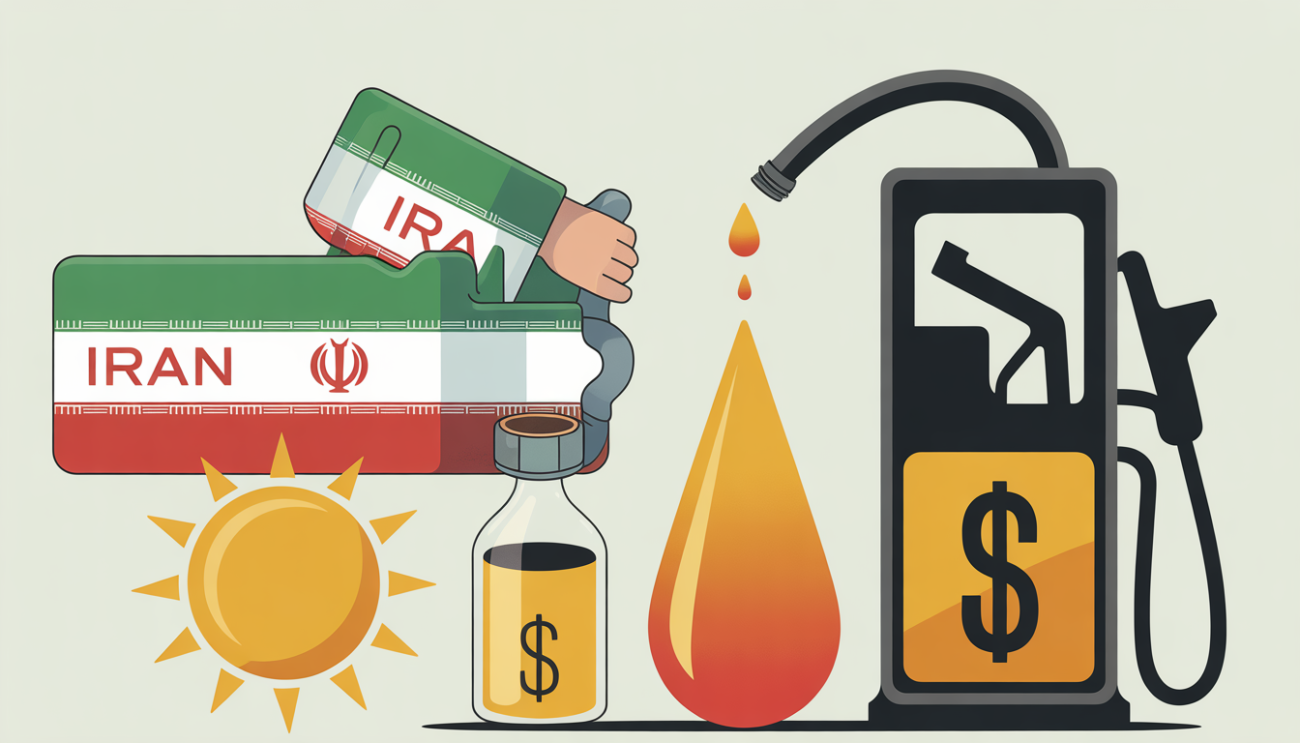
Americans are feeling a painful squeeze at the pump. The price of gasoline is shooting up across the country. This is happening because of the growing war between the United States, Israel, and Iran. The conflict in the Middle East is disrupting oil supplies and sending energy costs higher. This is bad news for the US economy and for everyone who drives a car. It is making the inflation outlook much worse.
How Much Have Gas Prices Gone Up?
The numbers are striking. The national average gasoline price reached $3.41 per gallon on March 7, 2026 . That might not sound too high by itself. But what matters is how fast it got there. Prices rose by 43 cents over just one week .
To put this in perspective, US crude oil recorded its largest weekly gain on record. This data goes all the way back to 1983 . When crude oil prices go up this fast, gasoline prices follow. And there is more bad news: prices will likely keep going up.
By March 8, the average price for regular gasoline had climbed even higher to $3.45 per gallon. That is an increase of almost 16 percent in a single week . For a family that fills up their car once a week, this adds up quickly.
The US Energy Secretary acknowledged the impact on American families. He said the administration wants gas prices back below $3 a gallon and promised they would be there “before too long” . But many experts are not so sure.
Why Are Gas Prices Rising So Fast?
The main reason is the war in the Middle East. The United States and Israel launched a large-scale attack on Iran on February 28, 2026 . Iran has responded with its own strikes across the region. This fighting has caused major problems for the global oil supply.
The Strait of Hormuz Problem
The biggest issue is the Strait of Hormuz. This is a narrow waterway between Iran and Oman. It is one of the most important shipping routes in the whole world. About one-fifth of the world’s oil supply passes through this strait every day .
Iran has effectively closed the strait by attacking ships and threatening tanker traffic. For six days, transit through the strait remained near a standstill. Only Iran-linked tankers were making the crossing .
The US government has announced a $20 billion reinsurance program and suggested using Navy escorts to protect ships. But normal traffic is nowhere near resuming. The Energy Secretary admitted that “worst case, that’s a few weeks, that’s not months” .
Fear Is Driving Prices Higher
Not all of the price increase is due to actual oil shortages. Some of it is what experts call a “fear premium.” The US Energy Secretary explained that “you’re seeing a little bit of fear premium in the marketplace. But the world is not short of oil today or natural gas” .
He said that what we are seeing is “emotional reactions and fear that this is a long-term war” . He insisted that this is not a long-term war but a temporary movement. However, many investors and traders are not convinced. They are buying oil now because they worry it will be even more expensive later.
Production Is Being Disrupted
Beyond shipping problems, actual oil production is being affected. Major oil producers in the region, including Iran, Kuwait, and the United Arab Emirates, have reduced output. They are doing this because of the security situation and because their storage facilities are filling up .
When producers stop pumping oil, there is less oil available for the whole world. Less supply means higher prices.
What Does This Mean for Inflation?
Higher gas prices are a major driver of inflation. When energy costs go up, it affects almost everything. Food costs more because farms and trucks need fuel. Products cost more because factories need energy to run. Shipping costs go up, and those costs are passed on to consumers.
The Inflation Numbers
Bank economists are now predicting that inflation will persist for several more months. This is partly due to the Iran war pushing up oil prices . The American Bankers Association’s Economic Advisory Committee expects inflation to remain above the Federal Reserve’s 2 percent target for the next eight quarters .
They predict that personal consumption expenditures inflation, which is the Fed’s preferred measure, will peak at 2.8 percent during the second quarter of this year . It will then cool off slowly, reaching 2.2 percent by late 2027 .
Morgan Stanley Research estimates that a 10 percent rise in oil prices from a supply shock could lift headline consumer prices in the US by about 0.35 percent over the next three months . The longer prices stay high, the more meaningful the increase in inflation will be.
A Warning from Economists
Gregory Daco, the chief economist at EY, explained that the situation is complicated. He said the decline in jobs and rising unemployment risks could weaken economic growth. At the same time, the Middle East conflict increases inflation risks . This creates a difficult problem for policymakers.
One economist warned that with Brent crude at $120, you are looking at zero growth in the economy. That is the trigger for a recession . Oil prices have already topped $100 and could go higher.
How This Affects American Families
Higher gas prices hit regular people the hardest. When you have to drive to work or school, you cannot avoid buying gas. You just have to pay whatever the price is.
The Impact on Spending
When households face higher gasoline costs, they have to make choices. Some people may dip into their savings at first. This can support spending for a little while. But it is not sustainable.
Morgan Stanley’s analysis shows that real consumption begins to decline two to three months after a price shock. It can remain depressed for another five to six months . The size of the economic drag depends on how long higher energy prices last.
The Political Impact
With midterm elections coming up in November, affordability is a key issue for voters. A Reuters/Ipsos poll reported that only about 27 percent of Americans approve of the US strikes on Iran . If the conflict is short, public dissatisfaction might fade quickly. But if it goes on longer, political attention will stay focused on cost-of-living pressures .
President Trump said that rising gasoline prices are not his main concern. He told Reuters, “I don’t have any concern about it. Gas prices will drop very rapidly when this is over” . But many Americans are concerned right now.
What the Federal Reserve Is Thinking
The Federal Reserve has a very difficult job right now. It has two main goals: keeping prices stable and maximizing employment. The current situation makes both goals harder to achieve.
Different Views from Fed Officials
Federal Reserve officials have different opinions about what will happen.
San Francisco Federal Reserve President Mary Daly described the situation as “a balance of risks calculation” . The Fed has to weigh the risk of higher inflation against the risk of weaker economic growth.
New York Fed President John Williams said it is too early to make broad judgments. He said we have to observe how long the disruption lasts . So far, the impact on financial markets has been “quite moderate” .
But Fed Governor Christopher Waller offered a more optimistic view. He said he does not expect the Iran war to have a sustained impact on inflation . He acknowledged that consumers will experience “sticker shock” as gas prices rise. But he said policymakers typically look through such one-off increases .
Waller explained that when we look at core inflation, it is a more reliable predictor of future inflation. He said it would be “kind of strange” to assume the Fed might change interest rate policy in six months just because of this event .
The Risk of a Longer Conflict
Waller did admit there is a risk. If the oil price shock becomes “more long-lasting,” then it could start to spread to other parts of the economy . That is when it becomes a real problem.
What This Means for Interest Rates
The Fed had been expected to cut interest rates this year. Those expectations are now changing. Markets are pricing in a tougher stance from the central bank.
The American Bankers Association panel expects only one interest rate cut of 25 basis points between now and early next year . They expect the Fed to leave the federal funds rate between 3.25 and 3.50 percent .
Economists say the Fed may face a difficult path. If inflation rises while economic growth weakens, the Fed cannot easily solve both problems. Fighting inflation might mean raising rates, but that could slow growth even more. Supporting the economy might mean cutting rates, but that could add fuel to inflation .
How Long Will High Prices Last?
This is the big question on everyone’s mind. The answer depends on the war.
The Government’s View
The Trump administration argues that this is a short-term disruption. White House Press Secretary Karoline Leavitt said, “We’re seeing a slight increase in oil and gas prices, but ultimately, taking out the rogue Iranian regime is going to be a good thing for the oil industry” .
The Energy Secretary said that in the worst case, the disruption is a matter of weeks, not months. He insisted that “the oil is there” and that the world is not short of oil .
A Warning from Qatar
Not everyone is so optimistic. Qatar’s Energy Minister warned that the Middle East conflict could “drag down the world economy” . He said Gulf energy producers may need to declare force majeure in the coming days and shut down some production. This could push oil prices up to $150 per barrel .
If oil hits $150 and stays there, the impact on inflation would be severe. One analysis shows that if oil prices stay at $100 through the end of the year, the December CPI could rise to 3.48 percent . If oil hits $150 in March and April, CPI could spike above 4 percent .
What History Tells Us
Morgan Stanley Research notes that markets have historically tended to post gains during wartime. This includes double-digit increases during both Gulf Wars . But that does not mean inflation is not a concern.
The key variable is duration. A short, contained conflict can keep economic spillovers limited. However, a conflict longer than a few weeks raises the odds of sustained economic pressure through higher oil prices and hotter inflation .
A Simple Summary
Gas prices are soaring across the United States. The national average has jumped by about 45 cents in just one week. This is happening because of the war between the US, Israel, and Iran. The conflict has disrupted shipping through the Strait of Hormuz, where one-fifth of the world’s oil passes. Major oil producers have cut output, and fear is driving prices even higher.
Higher gas prices are making inflation worse. Bank economists now expect inflation to stay above the Fed’s target for two more years. American families are feeling the squeeze, with higher costs for gasoline, food, and everything that requires transportation.
The Federal Reserve is watching closely. Some officials think this is temporary and will not require policy changes. Others warn that a longer conflict could spread inflation throughout the economy. For now, the outlook depends on how long the war lasts. If it ends quickly, prices may come down. If it drags on, Americans could face much higher costs for a long time to come.
