
There are moments in life when balance feels like a faraway dream. We chase after goals, speed through our days, and often forget to pause, breathe, and find stillness. In yoga, there is a pose that beautifully symbolizes the art of balancing strength and calm — the Eagle Pose (Garudasana). It’s not just a physical posture; it’s a gentle reminder of how grace emerges from focus, patience, and control.
Just as a powerful car demands control of its steering, our body and mind require harmony to move smoothly through life. Eagle Pose is where you learn that true power isn’t about force — it’s about mastery. Let’s dive deep into this beautiful pose, exploring its meaning, origins, benefits, techniques, and how it can transform both your body and your mindset.
1. The Meaning Behind Eagle Pose (Garudasana)
In Sanskrit, Garuda means eagle, and asana means pose. The eagle is not an ordinary bird in Indian mythology — it’s the king of birds, the divine vehicle of Lord Vishnu. It represents power, precision, and vision. When you practice Eagle Pose, you embody these same qualities — alertness, clarity, and determination.
Think of an eagle in flight. It soars high above, calm and composed, yet fierce and focused when it needs to strike. This is exactly the energy Eagle Pose cultivates — a still body with an active, alert mind.
2. The Philosophy of Garudasana
Eagle Pose teaches the balance between tension and release. When you twist and wrap your limbs, the body feels tight and restricted at first. But as you breathe through the discomfort, something magical happens — the restriction becomes liberation. It’s a living example of how challenges in life shape our strength and bring clarity.
Just like a driver controlling a powerful car on a sharp turn, Garudasana asks you to find steadiness in motion. You might wobble or fall, but with practice, you learn to regain control — to trust the process rather than rush through it.
This pose, in essence, represents self-mastery — the art of controlling your energy, emotions, and thoughts with discipline and grace.
3. Preparing the Body for Eagle Pose
Before soaring like an eagle, you need to prepare your body. The pose requires flexibility in the shoulders, hips, and thighs, as well as balance and focus. Here’s how you can warm up effectively:
| Preparation Step | Purpose | Example Pose |
|---|---|---|
| Gentle Shoulder Rolls | Loosen the upper body and improve mobility | Roll shoulders forward and backward 10 times |
| Standing Forward Bend (Uttanasana) | Stretches hamstrings and lower back | Bend forward with soft knees |
| Chair Pose (Utkatasana) | Builds leg strength and balance | Hold for 5–8 breaths |
| Arm Cross Stretch | Opens shoulder joints | Cross one arm over the other and hold |
| Tree Pose (Vrksasana) | Enhances balance | Stand on one leg, place foot on inner thigh |
Once you feel your muscles relaxed and your breath steady, you’re ready to experience the elegance of Eagle Pose (Garudasana).
4. Step-by-Step Guide to Performing Eagle Pose
Let’s break down Eagle Pose in a simple and approachable way. Remember, yoga isn’t about perfection — it’s about connection.
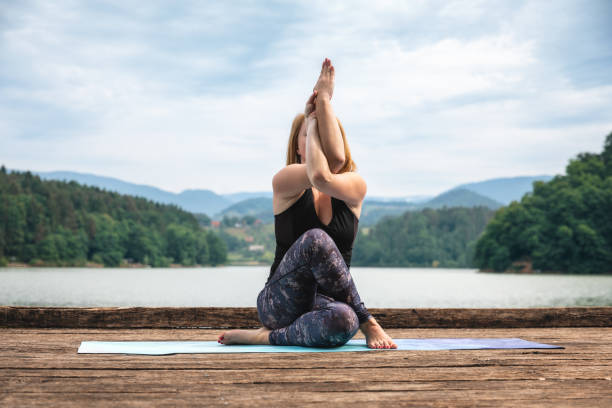
- Start with Stability:
Stand tall in Tadasana (Mountain Pose). Keep your feet together, shoulders relaxed, and spine straight. Take a deep breath and feel the ground beneath your feet. - Shift Your Weight:
Slowly transfer your weight to your right leg. Keep your right knee slightly bent to maintain balance. - Wrap the Left Leg:
Lift your left leg and cross it over your right thigh. If possible, hook the left foot behind your right calf. If not, simply rest it against the outer leg. Balance is key — don’t force it. - Interlace the Arms:
Extend both arms forward at shoulder height. Cross the right arm over the left, then bend the elbows so that the forearms wrap. Try to bring your palms together or touch the backs of your hands. - Find Your Focus:
Lift your elbows slightly and keep your gaze fixed on a steady point ahead. Take slow, deep breaths. Feel the wrapping and twisting — it symbolizes strength within stillness. - Hold the Pose:
Stay for 20–30 seconds, breathing deeply. With every exhale, feel your body becoming lighter, your mind calmer. - Release and Switch Sides:
Gently unwind your limbs and return to Mountain Pose. Then repeat on the opposite side.
5. The Deep Benefits of Eagle Pose (Garudasana)
Like the precision of a luxury car’s design, Eagle Pose brings harmony between the mechanical and the emotional. It builds focus, steadiness, and control — qualities that transcend yoga and flow into everyday life.
Physical Benefits:
- Improves balance and coordination: Strengthens stabilizer muscles in the ankles, knees, and hips.
- Enhances flexibility: Opens shoulders, upper back, and hips.
- Strengthens legs and arms: Builds endurance through controlled tension.
- Stimulates blood circulation: Twisting action increases oxygen flow to joints and tissues.
- Releases tension: Especially effective for those with tight shoulders or neck stiffness from sitting long hours.
Mental and Emotional Benefits:
- Sharpens concentration: The challenge of maintaining balance improves mental clarity.
- Promotes patience: You learn to stay calm even when you wobble.
- Encourages emotional release: The twisting action is symbolic of letting go of inner knots — stress, worry, and doubt.
- Boosts self-confidence: Each successful balance strengthens your inner trust.
Practicing Eagle Pose daily can rewire how you approach challenges — with calm determination instead of panic. Just like a driver learns to handle a high-speed turn with confidence, your body learns to trust itself under pressure.
6. Breathing in Eagle Pose: The Secret Element
Many beginners focus on the physical part of Eagle Pose, forgetting the most powerful tool — breath. The pose demands focus, and your breath is what anchors you there.
When your limbs are tightly wrapped, breathing can feel restricted. But that’s the moment to dig deeper. Take slow, conscious breaths through your nose. With every inhale, visualize calm energy rising. With every exhale, imagine tension leaving your body.
This rhythmic breathing transforms Eagle Pose into a moving meditation — a dance between effort and ease.
7. Common Mistakes and How to Fix Them
Even advanced practitioners sometimes make subtle mistakes in Eagle Pose (Garudasana). Let’s identify them and learn how to correct them gracefully:
| Common Mistake | What Happens | How to Fix It |
|---|---|---|
| Losing balance frequently | Core not engaged | Draw your belly in and focus your gaze forward |
| Shoulders tense or raised | Causes neck strain | Relax shoulders down from ears |
| Forcing the leg wrap | May twist the knee | Keep foot on outer calf instead of forcing behind it |
| Forgetting to breathe | Creates stiffness | Maintain steady breathing rhythm |
| Elbows dropping | Reduces shoulder stretch | Keep elbows lifted in line with shoulders |
Remember, yoga is not a race. Perfection in Eagle Pose comes from patience and awareness — not pressure.
8. The Symbolism of the Eagle: A Lesson in Vision
The eagle has the ability to see miles ahead, flying high yet noticing even the smallest movement below. When you hold Eagle Pose, you cultivate that same visionary focus. You stop reacting to distractions around you and instead see the bigger picture of your journey.
Whether in yoga or in life, this pose reminds you to rise above confusion, to stay calm even when everything around you feels stormy. Like the eagle that uses strong winds to soar higher, you too can use challenges to lift yourself upward.
9. Adapting Eagle Pose for Beginners
If you’re new to yoga or find balancing difficult, here are some ways to modify Eagle Pose without losing its essence:
- Use a wall for support: Stand near a wall to catch yourself if you wobble.
- Keep toes on the ground: Instead of wrapping your foot around the calf, let it rest on the floor.
- Do arm-only version: Practice just the arm twist (Garudasana arms) while standing upright.
- Sit and practice: Try the arms and gentle leg cross while seated on a chair.
These modifications build confidence and strength gradually. Over time, your body will naturally find stability — just as a driver learns smooth control after many drives.
10. The Energy Within: Chakras and Garudasana
In yoga philosophy, every pose influences certain chakras or energy centers. Eagle Pose mainly activates the Ajna Chakra (Third Eye) and the Muladhara Chakra (Root).
- Ajna Chakra (Third Eye): Located between your eyebrows, it governs intuition and insight. When balancing in Eagle Pose, your focus strengthens this inner vision.
- Muladhara Chakra (Root): Found at the base of your spine, it represents grounding and security. Balancing on one leg stimulates this energy, helping you feel stable and confident.
When both these chakras align, you gain a powerful combination — deep intuition with unshakable grounding. It’s like having the perfect balance of speed and control in a finely tuned machine.
11. Building a Routine with Eagle Pose
To experience the full benefits of Eagle Pose (Garudasana), consistency is key. You can integrate it into your daily yoga routine easily.
| Practice Goal | How to Include Eagle Pose |
|---|---|
| Morning Energy Boost | Perform after warm-up to awaken muscles |
| Midday Focus Reset | Practice for 3 minutes to regain concentration |
| Evening Stretch | Include in your cool-down flow to release tension |
| Strength Training | Combine with Chair Pose and Warrior III for balance power |
| Stress Relief | Hold longer with deep breathing to calm the mind |
12. The Spiritual Significance of Eagle Pose (Garudasana)
When you enter Eagle Pose, you wrap yourself in layers — arms, legs, and emotions. Beneath those layers, you discover stillness. That stillness is not just physical; it’s spiritual.
The eagle, in many traditions, represents freedom of spirit, clarity of thought, and divine vision. In yoga, Eagle Pose symbolizes rising above worldly chaos and connecting with your higher self.
Each twist and balance in this pose reflects a life lesson:
- When you’re wrapped in challenges, stay centered.
- When vision seems blurred, keep your eyes steady on your goal.
- When you feel restricted, breathe through it — because freedom begins within.
Spiritually, Garudasana teaches surrender — not of weakness, but of trust. You surrender the need to control everything and instead focus on being present. Like an eagle flying through storms, you learn to navigate life’s winds without losing your direction.
13. Emotional Healing Through Eagle Pose
We all carry emotional knots — hidden stress, unspoken words, or buried feelings. These tensions often sit quietly in our shoulders, hips, and neck. When you practice Eagle Pose (Garudasana), you gently untie those knots.
As you twist and balance, the pose activates the body’s energy flow, allowing emotional blocks to release. You may even feel tears or warmth rising — and that’s healing.
Many yoga teachers describe Eagle Pose as a “hug to yourself.” The wrapping of arms feels like self-embrace, reminding you that comfort begins from within. It teaches you to be gentle with yourself — to hold yourself with love even when life feels tight.
When practiced mindfully, Garudasana becomes a meditation in motion. Each breath, each balance, each moment of stillness helps clear emotional fog and restore peace.
14. Advanced Variations of Eagle Pose
Once you’re comfortable with the classic Eagle Pose, you can explore its deeper variations for challenge and creativity. These variations build greater strength, flexibility, and focus.
1. Full Eagle Pose with Forward Bend
After achieving balance in Garudasana, gently bend forward from the hips while keeping your back straight.
This intensifies the stretch in your upper back and hips, improving flexibility and grounding energy.
2. Seated Eagle Pose (Chair Version)
Sit on a chair and cross your legs just like the standing version. Wrap your arms in Garudasana position.
Perfect for beginners or those with knee discomfort, it focuses on shoulder and upper body release.
3. Reclined Eagle Pose (Supta Garudasana)
Lie on your back, cross your legs, and wrap your arms the same way.
This version is deeply restorative, great for relaxing after a long day or post-workout tension release.
4. Eagle Pose with Leg Lift
Once stable, lift your upper leg slightly off the base leg, engaging your core fully.
It enhances coordination and builds control — a true test of mental focus.
15. How to Integrate Eagle Pose in Yoga Sequences
Eagle Pose (Garudasana) fits beautifully in various yoga sequences. Whether your goal is balance, flexibility, or focus, you can include it in your practice like this:
| Yoga Sequence Type | Example Poses with Eagle Pose | Purpose |
|---|---|---|
| Morning Energizing Flow | Mountain Pose → Chair Pose → Eagle Pose → Warrior III → Tree Pose | Boosts balance and confidence |
| Evening Relaxation Flow | Cat-Cow → Seated Forward Bend → Seated Eagle → Supine Twist → Corpse Pose | Relieves tension and calms the mind |
| Strength and Focus Flow | Chair Pose → Eagle Pose → Warrior II → Triangle Pose → Standing Forward Bend | Builds stamina and concentration |
| Restorative Flow | Reclined Eagle → Happy Baby → Legs-up-the-wall → Meditation | Encourages emotional release and relaxation |
Practicing Eagle Pose regularly in such sequences helps the body develop flexibility while the mind grows sharper and calmer.
16. Mindfulness and Focus in Garudasana
Mindfulness is the silent force behind every yoga pose, but it feels especially alive in Eagle Pose.
When you balance on one leg and twist your arms and legs, your mind wants to wander — maybe to what’s for dinner or what message just buzzed on your phone. But Garudasana doesn’t let you escape. It demands presence.
You realize that the only way to stay steady is to be here — fully and consciously.
Every wobble becomes a lesson in awareness. Every deep breath becomes a bridge between body and soul. This is why Eagle Pose is often described as a mindfulness mirror — it reflects how focused or distracted your inner world really is.
Over time, the lessons from your mat begin to shape your daily life. You walk with more intention, react less, and think with greater clarity. You learn that balance in yoga is the foundation of balance in life.
17. The Connection Between Eagle Pose and Inner Confidence
When you first attempt Eagle Pose, it may feel awkward. You might lose balance, unwrap too early, or feel like your limbs just won’t cooperate. But that’s the magic of this pose — it humbles you, then rebuilds your strength from within.
Each time you try again and hold a little longer, you develop a quiet confidence. It’s not about showing off; it’s about knowing you can center yourself no matter what.
This is the same energy that powerful individuals radiate — calm power, silent determination. Eagle Pose helps awaken that in you.
Confidence doesn’t come from standing tall; it comes from standing steady — even when things feel twisted.
18. Comparing the Eagle Pose to Life and Motion
For those who love cars, you’ll understand this easily. Think of Eagle Pose as your internal test drive. When you drive a car, you feel every vibration, every curve, every change in the road. Balance and control are everything.
In Garudasana, you’re the driver and the vehicle. Your body responds to the smallest shifts in your mind. If you tense up, you lose balance — just like a car sliding off its track. But when you stay calm, when your focus is smooth and your breathing is steady, everything aligns.
Like a finely tuned engine, your body moves effortlessly when all its parts work together. Eagle Pose teaches this connection — precision, patience, and flow.
19. Tips for Perfecting Eagle Pose
Perfection in yoga is not about shape, but awareness. Still, there are ways to refine your Eagle Pose (Garudasana) practice:
- Engage Your Core:
Keep your abdominal muscles slightly pulled in to maintain center stability. - Find Your Drishti (Gaze Point):
Focus your eyes on one unmoving spot to enhance balance and concentration. - Soften Your Shoulders:
Even as your arms twist, let your shoulders relax away from the ears. - Feel the Ground Beneath You:
Distribute weight evenly across your standing foot. The more grounded you are, the higher you can “fly.” - Breathe with Intention:
Deep, slow breaths keep the pose alive and steady. - Smile Gently:
The moment you smile, your nervous system relaxes — and the body follows. Remember, balance thrives on ease.
20. The Psychological Power of Eagle Pose
Beyond muscles and balance, Eagle Pose shapes the mind. The wrapping posture creates a sense of containment — almost like a protective cocoon. It teaches emotional self-control and focus under pressure.
Psychologists often note that poses requiring balance enhance cognitive awareness and self-regulation. When practiced regularly, Eagle Pose can help reduce anxiety, sharpen decision-making, and increase patience.
It trains you to stay composed in the middle of chaos — to breathe through uncertainty. In that way, it’s not just a yoga pose; it’s a daily life training ground.
21. How to Use Eagle Pose for Stress Relief
Whenever stress takes over, Eagle Pose can become your instant therapy. Here’s how:
- Step away from your desk or routine.
- Stand tall, focus on your breath, and slowly enter Garudasana.
- Hold for a few deep breaths, then release.
As you twist and balance, your nervous system resets. The focus required in the pose gently quiets mental noise, grounding you in the present moment.
Think of it as rebooting your inner engine — slowing down thoughts and recharging your emotional fuel.
22. Symbolic Reflection: The Eagle and You
Eagles are known for flying higher than any other bird. They do not fear storms — they use the storm’s wind to rise even higher.
That’s the spirit of Eagle Pose (Garudasana). When life becomes stormy, don’t resist. Spread your wings and rise above. Every struggle becomes a current that lifts you.
This pose is not just about balance; it’s about transformation. It whispers, “Even when you feel twisted and tangled, you can still rise gracefully.”
Your body learns stability, but your heart learns courage.
23. When to Avoid Eagle Pose
While Eagle Pose is beneficial, it may not suit everyone. Avoid or modify it if you have:
- Knee or ankle injuries
- Shoulder dislocation
- Severe balance disorders
- Pregnancy (unless under supervision)
Always listen to your body. Yoga’s wisdom lies in sensitivity, not stubbornness.
24. A Simple Practice Plan
Here’s how you can include Eagle Pose in your daily yoga plan:
| Duration | Routine | Focus |
|---|---|---|
| 10 minutes | Warm-up → Eagle Pose (each side) → Child’s Pose | Morning energy |
| 15 minutes | Sun Salutations → Eagle → Warrior III → Tree Pose | Balance and strength |
| 20 minutes | Gentle Flow → Seated Eagle → Supine Twist → Meditation | Emotional relaxation |
| 5 minutes | Single pose with mindful breathing | Quick stress reset |
Even a few minutes daily can bring noticeable improvements to your physical and emotional balance.
25. The Journey Beyond the Pose
Every yoga pose is a metaphor for life. Eagle Pose is about wrapping, twisting, and then unfolding — stronger, clearer, and lighter.
When you first begin, your body might resist. You might wobble or feel off-balance. But that’s where growth happens. Every practice teaches patience. Every fall teaches resilience. Every rise teaches faith.
And slowly, without realizing it, Eagle Pose (Garudasana) becomes a way of thinking — a way of living.
You start handling life’s tight turns more gracefully. You respond instead of reacting. You breathe instead of breaking down.
That’s when you truly understand the magic of this pose — it’s not just a physical posture, but a mindset of strength in stillness.
26. The Final Takeaway: Soaring Like an Eagle
In a world that constantly pushes us to hurry, Eagle Pose is a pause — a reminder to be powerful yet peaceful, strong yet flexible.
It tells you that balance doesn’t mean stillness; it means harmony in motion. Just as a car glides smoothly when every part works in rhythm, your life flows effortlessly when mind, body, and spirit align.
So, the next time you step onto your mat, close your eyes, breathe, and enter Eagle Pose (Garudasana) — not as an exercise, but as an act of self-connection.
Feel the strength of your roots. Feel the lightness of your breath. Feel the elegance of balance.
You are the eagle — watchful, fearless, and free.
Conclusion:
Eagle Pose (Garudasana) isn’t about twisting your limbs; it’s about untangling your mind.
It’s a celebration of control, awareness, and the quiet power that comes from within.
When you master it, you don’t just balance on one leg — you balance in life.
Because balance, like freedom, begins the moment you trust yourself to soar.